
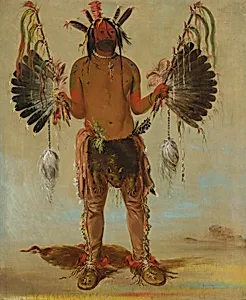
Mah-tó-he-ha, Old Bear, a Medicine Man
1832
Medium
Painting
Classification
Painting
Department
Smithsonian Collection
Museum
Smithsonian American Art Museum
Credit
Smithsonian American Art Museum, Gift of Mrs. Joseph Harrison, Jr.
Accession Number
1985.66.129
Rights
Public Domain
Tags
About this artwork
At twelve o'clock, “having used the whole of the fore-part of the day at his toilette,” George Catlin wrote, Old Bear arrived at the artist’s lodge “bedaubed and streaked with paints of various colours, with bear's grease and charcoal, with medicine-pipes in his hands and foxes tails attached to his heels [and] with a train of his own profession, who seated themselves around him . . . He took his position in the middle of the room, waving his eagle calumets in each hand, and singing his medicine...
Art Historical Context
In 1832, American artist George Catlin captured the striking likeness of Mah-tó-he-ha, known as Old Bear, a revered medicine man of the Mandan tribe, in this full-length portrait painted on-site at their village along the Missouri River. Catlin, a pioneering chronicler of Native American life, described the dramatic moment vividly: after a morning devoted to elaborate preparations, Old Bear arrived "bedaubed and streaked with paints of various colours," adorned with bear's grease, charcoal, medicine pipes, and fox tails on his heels. Surrounded by his fellow medicine men, he stood chanting his medicine song, waving eagle-feather calumets, as Catlin worked swiftly to immortalize him. This oil painting exemplifies Catlin's ethnographic style, blending portraiture with cultural documentation during his travels among Plains tribes in the early 19th century. Before widespread European influence disrupted indigenous traditions, Catlin sought to preserve these vanishing ways through realistic detail—evident in Old Bear's intricate regalia of Indian dress, symbols of spiritual power and healing. Housed in the Smithsonian American Art Museum, the work highlights the Mandan people's rich ceremonial life and Catlin's urgent mission to record it, offering visitors a window into a pivotal era of American history.
About the Artist
George Catlin · 1796–1872
George Catlin (1796–1872), born in Wilkes-Barre, Pennsylvania, to Putnam Catlin and Polly Sutton—who had been captured by Native Americans during the 1778 Battle of Wyoming—initially pursued a legal career. Trained at Litchfield Law School, he was admitted to the bar in 1819 but abandoned law after two years to study art in Philadelphia in 1823. Self-taught as a portraitist, Catlin quickly gained ...