
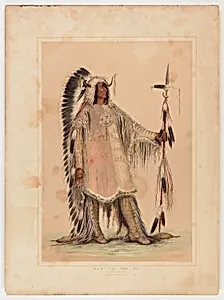
Mah-to-toh-pa, the Mandan Chief
Medium
Graphic Arts-Print
Classification
Graphic Arts-Print
Department
Smithsonian Collection
Museum
Smithsonian American Art Museum
Credit
Smithsonian American Art Museum, Transfer from the National Museum of Natural History, Department of Ethnology, Smithsonian Institution
Accession Number
1985.66.386,593S
Rights
Public Domain
Tags
Art Historical Context
George Catlin's *Mah-to-toh-pa, the Mandan Chief* a striking full-length print from his renowned series of Native American portraits, now housed in the Smithsonian American Museum. Created as a graphic arts print—likely a reproduction of Catlin's original 1830s oil painting work captures the dignified presence of Mah-to-toh-pa, as Four Bears, a prominent leader of the Mandan tribe along the Upper Missouri River.lin, a self-taught artist and ethnographer, traveled extensively in the American West during the early 19th century, painting over 600 portraits to document indigenous cultures he feared were vanishing due to westward expansion. Historically, this portrait holds immense significance as a visual record of Mandan life before devastating smallpox epidemics and U.S. encroachment decimated the tribe. Catlin's Romantic style emphasizes the chief's regal bearing—adorned in traditional regalia—blending ethnographic accuracy with artistic flair to humanize Native leaders for Eastern audiences. The print medium democratized access to these images, spreading awareness through exhibitions and publications. As a Smithsonian treasure, transferred from the National Museum of Natural History, it invites visitors to reflect on themes of cultural preservation and the complex legacy of 19th-century American art. (198 words)
About the Artist
George Catlin · 1796–1872
George Catlin (1796–1872), born in Wilkes-Barre, Pennsylvania, to Putnam Catlin and Polly Sutton—who had been captured by Native Americans during the 1778 Battle of Wyoming—initially pursued a legal career. Trained at Litchfield Law School, he was admitted to the bar in 1819 but abandoned law after two years to study art in Philadelphia in 1823. Self-taught as a portraitist, Catlin quickly gained ...