
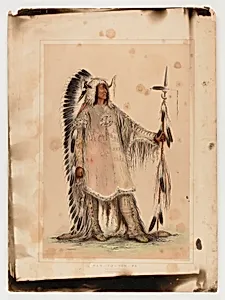
Mah-to-toh-pa, the Mandan Chief
Medium
Graphic Arts-Print
Classification
Graphic Arts-Print
Department
Smithsonian Collection
Museum
Smithsonian American Art Museum
Credit
Smithsonian American Art Museum, Transfer from the National Museum of Natural History, Department of Ethnology, Smithsonian Institution
Accession Number
1985.66.386,593AA
Rights
Public Domain
Tags
Art Historical Context
**Mah-to-toh-pa, the Mandan Chief** George Catlin captures the dignified presence of a prominent Mandan leader in a full-length portrait print. George Catlin, a pioneering19th-century American artist dedicated much of his career to documenting American tribes of the Great Plains through realistic portraits and scenes. This graphic arts print, housed in the Smithsonian American Art, exemplifies his commitment to preserving Indigenous cultures amid rapid change from European expansion. The Mandan people, who lived along the Upper Missouri in present-day North Dakota, were known for their fortified villages, agricultural practices, and vibrant ceremonies. Catlin visited their communities in the early 1830s, creating original oil paintings that were later reproduced as prints for wider audiences. These prints, transferred from the National Museum of Natural History's ethnology collection, played a crucial role in educating the public about Native lifeways, offering a rare glimpse into Mandan regalia, posture, and bearing before devastating epidemics and displacement. Artistically, Catlin's technique emphasized ethnographic accuracy over romantic idealization, using fine lines and shading in the print medium to convey texture and detail. This work not only highlights the chief's stature but also underscores the cultural significance of portraiture in honoring tribal leaders, making it a poignant artifact in American art history. (198 words)
About the Artist
George Catlin · 1796–1872
George Catlin (1796–1872), born in Wilkes-Barre, Pennsylvania, to Putnam Catlin and Polly Sutton—who had been captured by Native Americans during the 1778 Battle of Wyoming—initially pursued a legal career. Trained at Litchfield Law School, he was admitted to the bar in 1819 but abandoned law after two years to study art in Philadelphia in 1823. Self-taught as a portraitist, Catlin quickly gained ...