
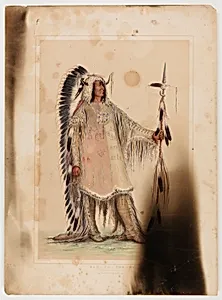
Mah-to-toh-pa, the Mandan Chief
Medium
Graphic Arts-Print
Classification
Graphic Arts-Print
Department
Smithsonian Collection
Museum
Smithsonian American Art Museum
Credit
Smithsonian American Art Museum, Transfer from the National Museum of Natural History, Department of Ethnology, Smithsonian Institution
Accession Number
1985.66.386,593CC
Rights
Public Domain
Tags
Art Historical Context
**Mah-to-toh-pa, the Mandan Chief** by George Catlin captures the dignified presence of a prominent Mandan leader in a striking full-length portrait. Rendered as a graphic arts print, this work reproduces Catlin's signature realistic style, likely derived from his original oil paintings created during his travels among Native American tribes in the early 19th century. The Smithsonian American Art Museum holds this piece, transferred from the National Museum of Natural History's ethnology collection, underscoring its value as both art and historical document. George Catlin, a pioneering American artist, dedicated much of his career to portraying Indigenous peoples of the Great Plains, including the Mandan, before their traditional ways were profoundly altered by European settlement. This print highlights the chief's regalia and stature, offering a window into Mandan culture—known for its fortified earth-lodge villages along the Missouri River. Catlin's meticulous attention to detail in clothing, pose, and expression aimed to preserve these vanishing worlds for posterity. As a testament to early ethnographic art, the portrait bridges fine art and anthropology, inviting visitors to reflect on themes of cultural encounter and preservation. Though the exact date remains unknown, its place in the Smithsonian Collection ensures Mah-to-toh-pa's legacy endures, reminding us of the rich diversity of America's Indigenous heritage.
About the Artist
George Catlin · 1796–1872
George Catlin (1796–1872), born in Wilkes-Barre, Pennsylvania, to Putnam Catlin and Polly Sutton—who had been captured by Native Americans during the 1778 Battle of Wyoming—initially pursued a legal career. Trained at Litchfield Law School, he was admitted to the bar in 1819 but abandoned law after two years to study art in Philadelphia in 1823. Self-taught as a portraitist, Catlin quickly gained ...