
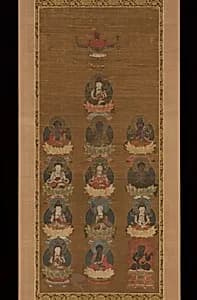
Mandala of the Thirteen Buddhas (Jūsan butsu mandara)
16th or 17th century
Medium
Hanging scroll; ink, color, and gold on silk
Dimensions
Image: 37 × 15 5/8 in. (94 × 39.7 cm) Overall with mounting: 63 1/4 × 21 in. (160.7 × 53.3 cm) Overall with knobs: 63 1/4 × 23 1/8 in. (160.7 × 58.7 cm)
Classification
Paintings
Culture & Period
Japan · Muromachi 1392–1573), Momoyama (1573–1615), or Edo (1615–1868) period
Department
Asian Art
Museum
Metropolitan Museum of Art, New York, NY
Credit
Gift of Sue Cassidy Clark, in honor of Barbara Brennan Ford, 2021
Accession Number
2021.396.1
Rights
Public Domain
Art Historical Context
Welcome to the Asian Art galleries at the Metropolitan Museum of Art where this exquisite *Mandala of the Thirteenhas (Jūsan butsu mandara)* transports visitors to Japan's Muromachi, Momoyama, or early Edo periods (16th or 17th century). by an unidentified artist, this hanging scroll depicts the sacred assembly of thirteen enlightened beings central to Japanese esoteric Buddhism, particularly the Shingon tradition. These figures—ranging from Buddhas to bodhisattvas and wisdom kings—are arranged in a symmetrical mandala pattern, symbolizing cosmic harmony and the path to enlightenment. Crafted on luxurious silk with ink, vibrant colors, and shimmering gold, the scroll exemplifies refined Japanese painting techniques. Gold leaf evokes divine radiance, while delicate ink lines and layered pigments create a luminous, otherworldly depth. Hanging scrolls like this were unrolled for meditation, rituals, or display in temples and homes, their narrow format (37 × 15⅝ in. for the image) ideal for intimate contemplation. Culturally, the Thirteen Buddhas held profound significance in funeral rites, invoked sequentially over 49 days to guide the deceased through realms of rebirth. Gifted in 2021 in honor of Barbara Brennan Ford, this rare survivor offers a window into Japan's spiritual life amid eras of samurai warfare and cultural renaissance, blending devotion with artistic mastery.