
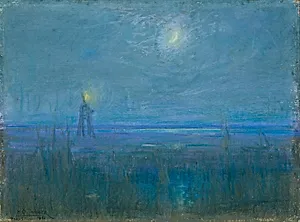
Marshes in New Jersey
Medium
Drawing
Classification
Drawing
Department
Smithsonian Collection
Museum
Smithsonian American Art Museum
Credit
Smithsonian American Art Museum, Gift of Mr. and Mrs. Alfred T. Morris, Jr.
Accession Number
1984.149.3
Rights
Public Domain
Tags
Art Historical Context
Henry Ossawa Tanner's *Marshes in New Jersey* (1895) is a delicate drawing that captures the serene, expansive wetlands of the American Northeast during a pivotal moment in the artist's early career. Born in Pittsburgh in 1859, Tanner was one of the first African American artists to achieve international recognition, overcoming racial barriers in the U.S. art world. This work, created when he was in his mid-30s, reflects his time studying and sketching in Philadelphia and nearby regions before his influential move to Paris in the late 1890s. The New Jersey marshes, with their vast, atmospheric expanses, evoke the quiet beauty of the American landscape, a theme Tanner explored before turning to luminous religious subjects. As a drawing—likely executed in graphite or charcoal on paper—this piece highlights Tanner's masterful command of line, tone, and subtle gradations to convey depth and mood. Drawings like this were essential studies for his oil paintings, demonstrating his realist approach infused with impressionistic sensitivity to light and atmosphere. Its simplicity underscores the medium's intimacy, allowing visitors to appreciate the raw observation of nature's textures, from swaying reeds to misty horizons. Housed in the Smithsonian American Art Museum through the generous gift of Mr. and Mrs. Alfred T. Morris, Jr., *Marshes in New Jersey* offers a window into Tanner's American roots and his role in expanding the visibility of Black artists in late 19th-century art. It's a testament to how everyday scenes could reveal profound artistic promise.