
Martin Hardie, No.1
1915
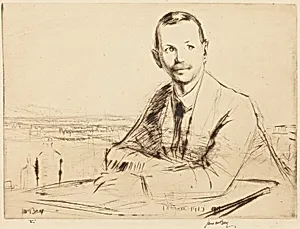
Medium
drypoint
Dimensions
sheet: 20.5 × 25.6 cm (8 1/16 × 10 1/16 in.)
Classification
Department
CG-W
Museum
National Gallery of Art, Washington, D.C.
Credit
Rosenwald Collection
Accession Number
1943.3.5988
Rights
Public Domain
Art Historical Context
James McBey’s “Martin Hardie, No.1,” created in 1915, is a fine example of early twentieth-century British printmaking. Executed in drypoint, the work captures a portrait with the medium’s characteristic soft, velvety lines produced by the burr raised along each incised stroke. Measuring just over eight by ten inches, the intimate scale encourages close looking and highlights the tactile quality of the printed surface. Drypoint was especially favored by artists of McBey’s generation for its direct, almost sketch-like immediacy, allowing spontaneous expression while still yielding rich tonal effects when inked and printed. As part of the National Gallery of Art’s Rosenwald Collection, this print joins a distinguished group of works that celebrate the graphic arts’ ability to convey personality and atmosphere with economical means. Though created on the eve of widespread wartime upheaval, the portrait stands as a quiet testament to artistic exchange and the enduring appeal of hand-printed imagery for museum visitors today.
About the Artist
James McBey · 1883–1959
James McBey (1883–1959) was a Scottish artist renowned for his etchings and paintings, emerging from humble beginnings in Newburgh, Aberdeenshire, as the illegitimate son of a blacksmith's daughter. Largely self-taught, he left school at fifteen to work as a bank clerk in Aberdeen, where he devoured art books from the public library and attended evening classes at Gray's School of Art to hone his ...