
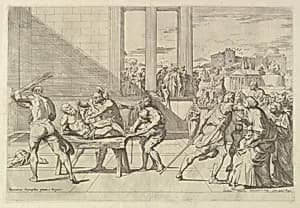
Martyrdom of Saint Andrew
Medium
Etching; second state of five (Bartsch)
Dimensions
sheet: 17 1/8 x 22 13/16 in. (43.5 x 58 cm) plate: 11 5/8 x 17 1/8 in. (29.5 x 43.5 cm)
Classification
Prints
Department
Drawings and Prints
Museum
Metropolitan Museum of Art, New York, NY
Credit
The Elisha Whittelsey Collection, The Elisha Whittelsey Fund, 1961
Accession Number
61.532.51
Rights
Public Domain
Tags
Art Historical Context
In the grand tradition of Baroque religious art, *Martyrdom of Saint Andrew captures the dramatic suffering of the apostle crucified on an X-shaped cross, surrounded by soldiers—a poignant emblem of faith amid persecution. Created between 1645 and 1660, this etching is attributed to Carlo Maratti, a leading Roman Baroque artist, likely reproducing a composition by his predecessor Domenichino (Domenico Zieri), a master of emotive, Carracci-influenced painting. Domenichino's style, with its dynamic figures and intense emotional depth, exemplifies the Counter-Reformation's call for vivid depictions of martyrdom to inspire devotion. Printed as the second state of five (per Adam Bartsch's catalog), this etching measures a substantial 17⅛ x 22⅞ inches on the sheet, showcasing the meticulous technique of intaglio printing. Etchings like this allowed grand altarpiece designs to reach wider audiences beyond churches, democratizing high art during the 17th century. Housed in the Metropolitan Museum of Art's Drawings and Prints department, part of The Elisha Whittelsey Collection, it highlights how prints preserved and propagated sacred narratives. Visitors will appreciate the work's raw intensity: Saint Andrew's agony, rendered with sharp lines and tonal contrasts, evokes both horror and reverence, a testament to Baroque art's theatrical power.
About the Artist
Carlo Maratti|Domenichino (Domenico Zampieri) · 1625–1713
Son of a Dalmatian father. Known as the last major Italian artist of the classical tradition, which had originated with Raphael. He created a grandiose and decorative style that was valued by his ecclesiastical patrons. Comment on works: History; Religious.