
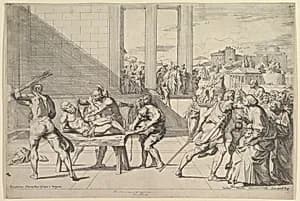
The Martyrdom of Saint Andrew
Medium
Etching; second state of five (Bartsch)
Dimensions
sheet: 15 15/16 x 21 15/16 in. (40.5 x 55.8 cm) plate: 11 13/16 x 17 5/16 in. (30 x 44 cm)
Classification
Prints
Department
Drawings and Prints
Museum
Metropolitan Museum of Art, New York, NY
Credit
Harris Brisbane Dick Fund, 1926
Accession Number
26.70.3(70)
Rights
Public Domain
Tags
Art Historical Context
Behold *The Martyrdom of Andrew*, a dramatic etching collaborative in spirit between two Baroque masters: Domenichino (Domenicoampieri), the Bolognese painter known for his emotive religious scenes influenced by the Carracci, and Carlo Maratti, leading Roman artist of the later 17th century. Created between 1645 and1670, this second state five (as cataloged by Adam Bartsch) captures apostle's crucifixion on an X-shaped cross amid a turbulent crowd of executioners and onlookers, evoking intense suffering and faith. Etching, the medium here, allowed for intricate lines and rich tonal contrasts on a grand scale—plate size 11 13/16 x 17 5/16 inches—making it ideal for disseminating powerful Counter-Reformation imagery. Domenichino's design likely provided the emotional core, with its dynamic figures and heightened drama, while Maratti's hand refined the plate, showcasing Baroque hallmarks like swirling compositions and theatrical light. Housed in the Metropolitan Museum of Art's Drawings and Prints department (Harris Brisbane Dick Fund, 1926), this print underscores the era's blend of devotion and artistry, inviting viewers to reflect on Saint Andrew's endurance. A testament to printmaking's role in spreading sacred narratives across Europe.
About the Artist
Carlo Maratti|Domenichino (Domenico Zampieri) · 1625–1713
Son of a Dalmatian father. Known as the last major Italian artist of the classical tradition, which had originated with Raphael. He created a grandiose and decorative style that was valued by his ecclesiastical patrons. Comment on works: History; Religious.