
Mary McIntosh Williams Sargent
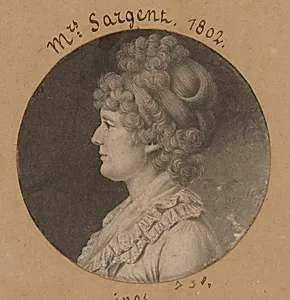
Medium
Classification
Department
Smithsonian Collection
Museum
Smithsonian American Art Museum
Credit
National Portrait Gallery, Smithsonian Institution; gift of Mr. and Mrs. Paul Mellon
Accession Number
S/NPG.74.39.16.18
Rights
Public Domain
Tags
Art Historical Context
In 1802, French-born artist Charles Balth Julien Févret de-Mémin captured the likeness of Mary McIntosh Williams in this elegant profile print, now housed in the Smithsonian American Art Museum's National Portrait Gallery. Saint-Mémin (1770–1852), who fled the French Revolution and settled in America, became renowned for his precise, miniature portraits that documented the early republic's elite. This work exemplifies his signature style: intimate, physiognomically accurate profiles that blended European sophistication with emerging American identity. Crafted as a print, likely an engraving derived from Saint-Mémin's innovative physiognotrace—a mechanical device that traced silhouettes with mathematical precision—the artwork highlights the era's fascination with physiognomy, the "science" of character revealed through facial features. These affordable prints democratized portraiture, making high-society likenesses accessible beyond oil paintings reserved for the wealthiest. As a gift from Mr. and Mrs. Paul Mellon, this piece preserves a glimpse of women's roles in post-Revolutionary America, where such portraits signified status and refinement. Sargent's poised profile invites us to ponder her world—elegant drawing rooms, burgeoning national pride, and the artistry bridging Old World techniques with New World optimism.