
Medicine Man, Performing His Mysteries over a Dying Man
1832
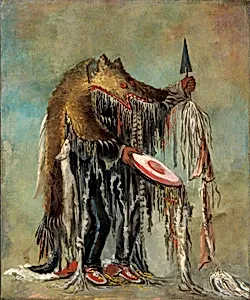
Medium
Painting
Classification
Painting
Department
Smithsonian Collection
Museum
Smithsonian American Art Museum
Credit
Smithsonian American Art Museum, Gift of Mrs. Joseph Harrison, Jr.
Accession Number
1985.66.161
Rights
Public Domain
Tags
About this artwork
In 1832, George Catlin witnessed a dramatic ritual at Fort Union, two thousand miles northwest of St. Louis. According to the artist, the medicine man began the healing by administering roots and herbs. If this failed, he would try “shaking his frightful rattles, and singing songs of incantation.” Catlin wrote that the medicine man’s clothing often consisted of “the skins of snakes, and frogs, and bats,---beaks and tows and tails of birds,---hoofs of deer, goats, and antelopes,” each possessing ...
Art Historical Context
In 1832, artist Catlin captured a riveting moment from his travels among Native American tribes at Fort Union, a remote trading post on the upper River. *Medicine Man Performing His Mysteries over a Man* depicts a Blackfoot healer in a dramatic ritual, bending over a patient while adorned in a striking costume of yellow bear skin and snake hides. Catlin, a pioneering chronicler of Indigenous life in the early 19th century, painted this as part of his ambitious Indian Gallery—a traveling exhibition aimed at preserving vanishing cultures amid rapid American expansion. The scene highlights the medicine man's multi-step healing process: first administering roots and herbs, then invoking power through rattling instruments and incantation songs. His regalia, featuring "anomalies or deformities" from animals like snakes, frogs, bats, and birds, symbolized supernatural healing forces. Catlin's realistic style, rooted in Romanticism, brings ethnographic detail to life, blending observation with spectacle— he even owned and occasionally wore the costume himself to dramatize his shows. This oil painting underscores the cultural clash and fascination of the frontier era, offering visitors a window into Blackfoot spiritual traditions rarely seen by outsiders. (198 words)
About the Artist
George Catlin · 1796–1872
George Catlin (1796–1872), born in Wilkes-Barre, Pennsylvania, to Putnam Catlin and Polly Sutton—who had been captured by Native Americans during the 1778 Battle of Wyoming—initially pursued a legal career. Trained at Litchfield Law School, he was admitted to the bar in 1819 but abandoned law after two years to study art in Philadelphia in 1823. Self-taught as a portraitist, Catlin quickly gained ...