
"Meeting of Bahram Gur with a Princess", Folio from a Shahnama (Book of Kings)
mid-16th century
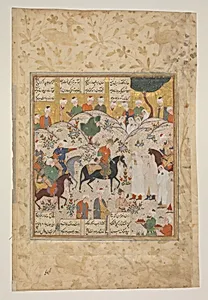
Medium
Ink, watercolor, and gold on paper
Dimensions
H. 14 1/4 in. (36.2 cm) W. 9 5/8 in. (24.4 cm)
Classification
Codices
Department
Islamic Art
Museum
Metropolitan Museum of Art, New York, NY
Credit
Rogers Fund, 1938
Accession Number
38.13
Rights
Public Domain
Tags
Art Historical Context
Step into the vibrant world of Persian epic poetry with this exquisite folio from a *Shahnama* (Book of Kings), titled *"Meeting of Bahram Gur a Princess."* Created in the mid-16th, it illustrates a romantic encounter from the tales of Bahram Gur, the legendaryasanian king famed for his prowess as a hunter and lover. The *Shahnama*, composed by the poet Abu'l Qasim Firdausi around1010 CE, chronicles Iran's mythical kings and heroes, blending history, legend, and moral lessons in over 50,000 couplets. This scene captures the poetic drama through dynamic human figures on horseback, evoking the chivalry and romance central to Persian literature. Rendered in ink, watercolor, and gold on paper (measuring 14¼ × 9⅝ inches), the artwork exemplifies Safavid Persian miniature painting, a pinnacle of Islamic art. Artists used fine brushes for intricate details—flowing robes, expressive faces, and architectural motifs—while gold illuminated architectural elements and halos, creating a luminous, otherworldly glow. These codices were prized treasures, often commissioned for royal libraries, blending text and image to make epic narratives accessible and visually enchanting. Housed in the Metropolitan Museum of Art's Islamic Art Department (Rogers Fund, 1938), this folio highlights the cultural fusion of poetry and painting in 16th-century Iran, where manuscripts like the *Shahnama* preserved national identity amid political change. Visitors will appreciate how its tags—horses, poetry, human figures—encapsulate the artistry's timeless appeal.
About the Artist
Abu'l Qasim Firdausi · 935–1020
Abu'l Qasim Firdausi, born around 940 in the village of Paj near Tus in Khorasan (modern-day Iran), emerged from a family of landed gentry known as dehqans, who preserved ancient Iranian oral traditions amid the cultural renaissance of the Samanid Empire. Little is documented about his early life or formal training, though he likely received a basic education including Arabic literacy, immersing h...