
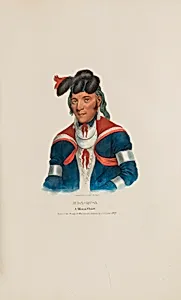
MI-A-QU-A; A Miami Chief, from The Aboriginal Portfolio
1835
Medium
Graphic Arts-Print
Classification
Graphic Arts-Print
Department
Smithsonian Collection
Museum
Smithsonian American Art Museum
Credit
Smithsonian American Art Museum, Gift of H. Lyman Sayen to his nation
Accession Number
1973.167.19
Rights
Public Domain
Tags
Art Historical Context
**MI-A-QU-A; A Miami Chief, from The Aboriginal Portfolio (1835) is a striking lithographic print by James Otto Lewis capturing the dignified likeness of Mi-a-qu-a, a prominent chief of the Miami tribe., an early 19th-century American artist and draftsman, created this portrait as part of his ambitious *Aboriginal Portfolio*, a of hand-colored lithographs documenting Native American leaders. Produced during a pivotal era of U.S. expansion, the work preserves the visage and regalia of Indigenous figures amid rapid cultural upheaval. Historically, this print emerges from Lewis's sketches made at intertribal treaty councils in the 1820s and 1830s, such as those in Indiana and Michigan Territory, where Native leaders negotiated with the U.S. government. The Miami, an Algonquian-speaking people of the Great Lakes region, faced forced relocation under policies like the Indian Removal Act. Lewis's portfolio, one of the earliest published collections of Native American portraits, offered Euro-American audiences a glimpse into these vanishing traditions, blending ethnography with artistry. As a graphic arts print via lithography—a revolutionary technique allowing precise, affordable reproduction— the work's fine lines and subtle coloring highlight Mi-a-qu-a's poised expression and traditional attire. Housed in the Smithsonian American Art Museum through a generous gift, it invites visitors to reflect on resilience and representation in American history. (198 words)