
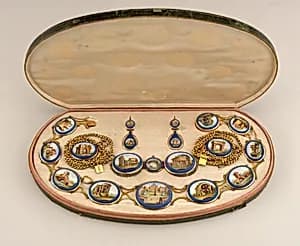
Micro-mosaic
1800–1825
Classification
jewelry
Department
Smithsonian Collection
Museum
Smithsonian American Art Museum
Credit
Gift of Frederick Saal in honor of Dr. and Mrs. Joseph Saal
Accession Number
1991-160-4-a,b
Rights
Public Domain
About this artwork
Research in Progress
Art Historical Context
This exquisite *Micro-mosaic* jewelry piece, dating from 1800–1825, a delicate technique popular in the early 19 century. Micro-mosaics involve arranging thousands of minuscule glass tesserae— no larger than grains of sand—to form intricate, jewel-like images with remarkable detail and luminosity. Worn as personal adornments, these works blended artistry with portability, appealing to affluent during an era of neoclassical revival and global travel. Though the artist remains unknown and research is ongoing, the piece's classification as jewelry highlights its role in everyday elegance and sentiment. Such micro-mosaics, likely inspired by ancient Roman techniques revived in Italian workshops, served as cherished souvenirs or heirlooms, capturing scenic views, mythological scenes, or portraits in miniature form. Their presence in the Smithsonian American Art Museum's collection underscores their artistic merit within American tastes. A generous gift from Frederick Saal in honor of Dr. and Mrs. Joseph Saal, this artifact invites visitors to ponder the craftsmanship of a bygone age. As studies continue, it promises further revelations about 19th-century decorative arts.
About the Artist
Unknown
The artist designated as "Unknown" in our virtual museum's collection exemplifies a poignant chapter in art history: creators whose identities have faded into obscurity despite the enduring power of their work. With only one known artwork attributed to them in our holdings, this figure represents countless anonymous hands that shaped visual culture across centuries. Museums worldwide, including th...