
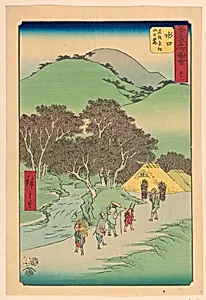
Minakuchi: Famous Pine Trees at the Foot of Mount Hiramatsu (Minakuchi, meisho Hiramatsu yama no fumoto) from the series 53 Stations of Tokaido
Classification
landscapes
Department
Smithsonian Collection
Museum
Smithsonian American Art Museum
Credit
Gift of the Estate of Mrs. Robert H. Patterson
Accession Number
1941-31-247
Rights
Public Domain
About this artwork
Research in Progress
Art Historical Context
Ando Hiroshige’s 1855 print *Minakuchi: Famous Pine Trees at the Foot of Mount Hiramatsu* belongs to his celebrated series depicting the fifty-three stations along Japan’s historic Tōkaidō highway. Created late in the artist’s career, the image captures a tranquil roadside view near the post town of Minakuchi, where majestic pines frame the lower slopes of Mount Hiramatsu. Hiroshige, one of the masters of ukiyo-e, specialized in landscapes that transformed everyday travel scenes into poetic visions of nature and human movement. The Tōkaidō route connected Edo (modern Tokyo) with Kyoto, serving merchants, pilgrims, and officials during the Edo period. Hiroshige’s series helped popularize this journey for a broad audience through affordable prints that combined precise observation with atmospheric effects of weather and season. Though the exact medium of this impression remains under study, its classification as a landscape underscores Hiroshige’s skill at distilling a sense of place into a few evocative elements. Today the work resides in the Smithsonian American Art Museum as part of a generous gift from the Estate of Mrs. Robert H. Patterson, allowing visitors to appreciate how Hiroshige’s vision continues to shape our understanding of nineteenth-century Japan and the enduring appeal of its countryside.