
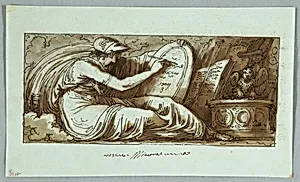
Minerva
Medium
figures
Classification
figures
Department
Smithsonian Collection
Museum
Smithsonian American Art Museum
Credit
Museum purchase through gift of various donors
Accession Number
1901-39-1644
Rights
Public Domain
About this artwork
Research in Progress
Art Historical Context
Felice Giani (1758–1823), a prominent Italian Neoclassical artist, *Minerva* in 1804, a work classified as "figures" now housed in the Smithsonian American Museum. Giani, trained in Bologna and active in Rome and Paris, renowned for his elegant depictions of mythological subjects, often blending classical antiquity with the refined aesthetics of the Napoleonic era. This piece reflects his mastery in capturing the poised grace of ancient deities, drawing from Greco-Roman traditions during a time when Neoclassicism celebrated heroic ideals and rational beauty. The subject, Minerva—the Roman goddess of wisdom, strategy, and the arts (equivalent to Greek Athena)—holds profound cultural importance, symbolizing intellect and craftsmanship in Western art. Giani's interpretation likely emphasizes her iconic attributes, rendered with precise lines and harmonious proportions typical of his draftsmanship and fresco designs. Acquired through museum purchase with gifts from various donors, *Minerva* enriches the Smithsonian's collection, bridging European Neoclassicism with American tastes. Though research on this specific work is ongoing, it invites visitors to ponder the enduring allure of mythology in early 19th-century art, a bridge between ancient lore and modern enlightenment.