
Miyako meisho no uchi
1850 - 1860
Medium
color woodcut
Dimensions
253; 186
Rights
Public Domain
About this artwork
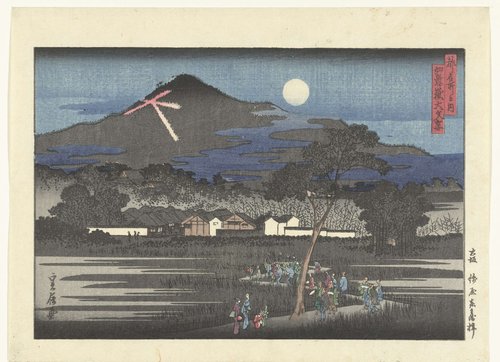
Avondlandschap met volle maan; mensen op een kronkelende weg over een vlakte, kijkend naar het op de berg verlichte teken 'dai', wat 'groot' betekent. Op open plekken op de helling van de Nyoigatake berg in Kyoto worden in de zomer tijdens het Obon festival vuren aangestoken die het teken 'dai' verlichten.
Art Historical Context
In the mid-19th century, Japan's Edo period, artist Hasegawa Sadanobu I the magic of Kyoto's summer nights in his color woodblock print *Miyako meisho no uchi* (One of the Famous Places of the Capital), created between 1850 and 1860. This intimate ukiyo-e print, measuring just 186 × 253 mm, exemplifies genre's focus on fleeting beauty and urban spectacles. Ukiyo-e masters like Sadanobu used intricate woodblock techniques—carving multiple blocks for layers of vibrant color—to produce affordable, mass-distributed images that brought famous sites to everyday viewers. The scene unfolds under a luminous full moon, depicting an evening landscape where figures wind along a path across a vast plain, their gazes fixed on the glowing kanji "dai" (大, meaning "great") blazing atop Nyoigatake mountain. This fiery kanji, formed by bonfires lit on the slopes during Kyoto's Obon festival, honors ancestors in a tradition blending reverence and communal joy. Obon, rooted in Buddhist practices, features dances, lanterns, and these massive illuminated symbols visible for miles, symbolizing life's grandeur amid the ephemeral. Sadanobu's delicate lines and subtle gradients evoke a serene yet festive mood, highlighting ukiyo-e's role in preserving cultural rituals just before Japan's modernization. A charming window into Edo-era Kyoto, it invites us to imagine the crackle of distant flames and whispers of ancient spirits.