
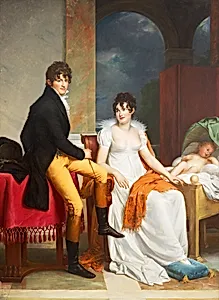
Moritz Christian Reichsgraf von Fries mit seiner Frau Maria Theresia Josepha, geb. Prinzessin Hohenlohe-Waldenburg-Schillingsfürst, und dem Sohn Moritz
um 1805
Medium
Öl auf Leinwand
Dimensions
223 × 163,5 cm
Classification
Gemälde
Department
Belvedere Collection
Museum
Belvedere
Credit
Belvedere, Vienna
Accession Number
3386
Rights
Public Domain
About this artwork
Die junge Familie gibt sich privat: Moritz Christian Reichsgraf Fries (1777–1826) trägt Reitkleidung, seine Frau Maria Theresia, geborene Prinzessin Hohenlohe-Waldenburg-Schillingsfürst (1779–1819), ein modisches, hochtailliertes Kleid ohne Schmuck. Ihr einjähriger Sohn Moritz liegt nackt in der Krippe. Die klassische Architektur im Hintergrund, der kostbare Kaschmirschal und der Fußpolster der Dame verweisen jedoch auf die gehobene Stellung der Dargestellten: Der Graf ist ein bedeutender Bankie...
Art Historical Context
This grand family portrait by François Pascal Simon Gérard captures Moritz Christian Reichsgraf von Fries, his wife Maria Theresia Josepha, and their infant son Moritz around 5. Painted in oil on a large canvas measuring over two meters high, the work presents the aristocratic couple in a moment of quiet domesticity. The count appears in riding attire, while his wife wears a simple, high-waisted Empire-style gown, and their one-year-old son rests unclothed in a crib—choices that emphasize personal intimacy over formal display. Yet subtle details reveal their elevated status. Classical architecture in the background, a luxurious cashmere shawl, and an ornate foot cushion allude to the family’s wealth and refinement. As a leading Viennese banker and art patron, Fries commissioned Gérard, one of the era’s most celebrated portraitists favored by French nobility, to create this impressive likeness. The painting thus bridges private tenderness with public prestige. Gérard’s neoclassical approach, marked by clear lines and balanced composition, suits the transitional moment between Enlightenment ideals and emerging Romantic sensibilities. The result offers viewers a rare glimpse into early nineteenth-century European aristocracy, where personal affection coexists with symbols of power and cultural influence.