
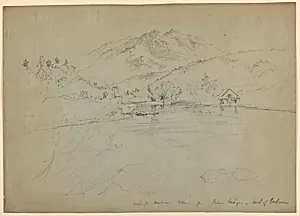
Mount Washington, Mount Madison and Mount Adams from Bridge, North of Gorham, New Hampshire
September 1862
Classification
landscapes
Department
Smithsonian Collection
Museum
Smithsonian American Art Museum
Credit
Bequest of Erskine Hewitt
Accession Number
1942-50-219
Rights
Public Domain
About this artwork
Research in Progress
Art Historical Context
Daniel Huntington's *Mount Washington, Mount Madison Mount Adams from Bridge, of Gorham, New* captures the majestic White Mountains in September 1862, offering a serene vista from a bridge north of Gorham. As an American artist (1816–1906) associated with the Hudson River, Huntington celebrated the sublime beauty of the nation's wilderness, blending precise observation with romantic idealism. This landscape reflects the mid-19th-century fascination with America's natural grandeur, a counterpoint to the era's rapid industrialization. Painted during the Civil War, the work evokes a sense of timeless tranquility amid national turmoil, inviting viewers to contemplate the enduring power of nature. The White Mountains, a popular destination for artists and tourists, symbolized national identity and exploration in Huntington's time. Though the medium remains unidentified, its classification as a landscape underscores the movement's emphasis on atmospheric light and vast scale. Bequeathed to the Smithsonian American Art Museum by Erskine Hewitt, this piece from the Smithsonian Collection highlights Huntington's skill in portraying specific locales with evocative detail. Research continues to uncover more about its creation, enriching our understanding of 19th-century American art.