
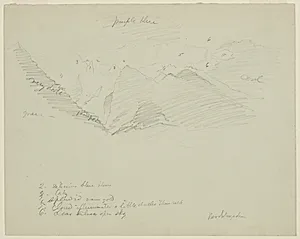
Mountains near Berchtesgaden, Bavaria (Germany)
June–July 1868
Classification
landscapes
Department
Smithsonian Collection
Museum
Smithsonian American Art Museum
Credit
Gift of Louis P. Church
Accession Number
1917-4-606
Rights
Public Domain
About this artwork
Research in Progress
Art Historical Context
Frederic Edwin Church, a leading figure in the Hudson River School of American landscape painting, created *Mountains nearchtesgaden, (Germany)* during a summer sketching trip in June–July 1868. Renowned his luminous, detailed depictions of nature's grandeur—such as *Niagara* and *The Heart of the Andes*—Church ventured beyond his familiar American subjects to capture the dramatic peaks of the Bavarian Alps This work reflects his lifelong fascination with majestic scenery, rendered on-site to preserve the fleeting light and atmosphere of Europe's alpine wonders. As a landscape classification from the Smithsonian American Art Museum's collection, the painting exemplifies Church's meticulous technique, likely emphasizing atmospheric effects and geological precision that defined 19th-century American Romanticism. Gifted by his son Louis P. Church, it offers a rare glimpse into the artist's European travels amid personal and professional transitions. Though research continues, this piece underscores Church's global vision, bridging American wilderness ideals with Old World splendor for viewers today.