
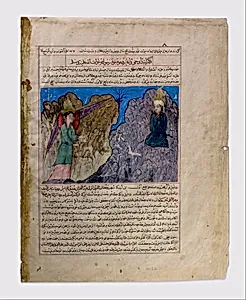
"Muhammad's Call to Prophecy and the First Revelation", Folio from a Majma' al-Tavarikh (Compendium of Histories)
ca. 1425
Medium
Opaque watercolor, silver, and gold on paper
Dimensions
Painting: H. 6 1/8 in. (15.5 cm) W. 8 3/4 in. (22.2 cm) Page: H. 16 7/8 in. (42.8 cm) W. 13 1/4 in. (33.7 cm) Mat: H. 19 1/4 in. (48.9 cm) W. 14 1/4 in. (36.2 cm)
Classification
Codices
Department
Islamic Art
Museum
Metropolitan Museum of Art, New York, NY
Credit
Cora Timken Burnett Collection of Persian Miniatures and Other Persian Art Objects, Bequest of Cora Timken Burnett, 1956
Accession Number
57.51.37.3
Rights
Public Domain
Tags
Art Historical Context
This exquisite folio, titled *"Muhammad's Call to and the First Revelation" comes from the *Majma' al-Tavarikh* (Compendium Histories), a grand 15th-century chronicle illustrated by the renowned Persian historian and artist Hafiz-i Abru 1425. Created during the Timurid dynasty's cultural zenith in Herat under Shah Rukh, it captures the pivotal moment when the Prophet Muhammad receives his first revelation from the angel Gabriel in the Cave ofira—an event central to Islamic faith, marking the dawn of the Quran. Hafiz-i Abru's miniature exemplifies Timurid Persian painting, with its intricate composition of robed men and ethereal angels rendered in opaque watercolor, shimmering silver, and gold on paper. These luxurious materials, applied with fine brushes, create a luminous, otherworldly glow, evoking divine light while adhering to Islamic aniconism by avoiding direct depiction of the Prophet's face. The small painting (6⅛ × 8¾ inches) fits within larger codex pages, highlighting the manuscript tradition's role in preserving history and spirituality. Housed in the Metropolitan Museum of Art's Islamic Art Department from the Cora Timken Burnett Collection, this folio offers a window into 15th-century Persia's blend of scholarship and artistry, inviting visitors to ponder the profound interplay of faith, history, and beauty.