
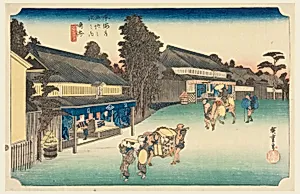
Narumi, A Place Famous for Its Cloth, in The Fifty-Three Stations of the Tokaido Road (Tokaido Gojusan Tsugi-no Uchi)
Classification
figures
Department
Smithsonian Collection
Museum
Smithsonian American Art Museum
Credit
Gift of Mary Rutherford Jay
Accession Number
1948-134-41
Rights
Public Domain
About this artwork
Research in Progress
Art Historical Context
Ando Hiroshige (1797–1858), a master of Japanese ukiyo-e woodblock, captured the beauty and bustle of everyday life along Japan's historic Tōkaidō Road in his renowned series *The Fifty- Stations of the Tōidō* (ca. 1833–1834). This print depicts Narumi, the fortieth station, celebrated for its fine cloth production. Travelers pause amid vibrant market scenes, where locals weave and trade textiles, blending human activity with the road's timeless rhythm. Hiroshige's genius lies in his atmospheric landscapes and dynamic compositions, influenced by the ukiyo-e tradition of "pictures of the floating world." Though the exact medium here is undocumented, his works typically feature intricate color woodblocks (nishiki-e), layering subtle gradients of blues, greens, and earth tones to evoke mood and movement. Narumi's portrayal highlights Edo-period commerce and pilgrimage, offering a window into 19th-century Japan before modernization. Part of the Smithsonian American Art Museum's collection, this piece invites visitors to ponder the Tōkaidō's cultural lifeline—linking Tokyo (Edo) to Kyoto—and Hiroshige's enduring legacy in inspiring global artists like Van Gogh. A poetic snapshot of transience and tradition!