
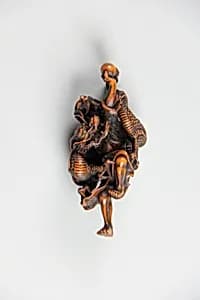
Netsuke of Dragon Coiled around the Body of a Man
Unknown Artist
19th century
Medium
Wood; inlaid glass eyes
Dimensions
H. 2 3/4 in. (7 cm); W. 1 1/8 in. (2.9 cm); D. 3/8 in. (1 cm)
Classification
Netsuke
Culture & Period
Japan · Edo (1615–1868) or Meiji period (1868–1912)
Department
Asian Art
Museum
Metropolitan Museum of Art, New York, NY
Credit
Bequest of Stephen Whitney Phoenix, 1881
Accession Number
81.1.120
Rights
Public Domain
Tags
Art Historical Context
This intricate netsuke, carved from wood in 19th-century Japan during the late Edo (1615–1868) or early Meiji (1868–1912) period, exemplifies the artistry of these tiny toggles. Netsuke served a practical purpose: securing inro (small medicine or tobacco pouches) to kimono sashes, as traditional Japanese attire lacked pockets. Prized for their whimsy and skill, they evolved from utilitarian objects into collectible sculptures, reflecting everyday life, folklore, and nature. Here, a fierce dragon coils dynamically around a man's body, capturing a mythical encounter with vivid tension. The unknown artist's mastery shines in the compact dimensions— just 2¾ inches high—where every scale, muscle, and fold is meticulously rendered in wood. Inlaid glass eyes add a startling realism, enhancing the creature's menacing gaze and drawing viewers into the drama. Dragons in Japanese culture symbolize power, water, and imperial authority, making this a potent talisman-like piece. Bequeathed to the Metropolitan Museum of Art in 1881 by Stephen Whitney Phoenix, this netsuke highlights the global fascination with Japanese crafts during the era's opening to the West. A testament to Edo-Meiji ingenuity, it invites us to marvel at miniature worlds frozen in time.