
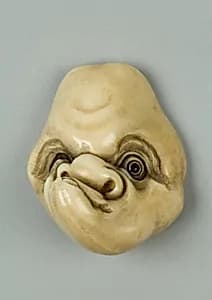
Netsuke of Mask with Man's Lopsided Face
Unknown Artist
19th century
Medium
Ivory
Dimensions
H. 2 in. (5.1 cm); W. 1 5/8 in. (4.1 cm); D. 1 1/8 in. (2.9 cm)
Classification
Netsuke
Culture & Period
Japan · Edo (1615–1868) or Meiji period (1868–1912)
Department
Asian Art
Museum
Metropolitan Museum of Art, New York, NY
Credit
Gift of Mrs. Russell Sage, 1910
Accession Number
10.211.1162
Rights
Public Domain
Tags
Art Historical Context
Nestled in the Metropolitan Museum of Art Asian Art collection, this charming ivory netsuke depicts a mask with a man's comically lopsided face, carved by an unknown Japanese artist in the 19th century. Measuring just 2 inches high, its petite scale (H. 2 in.; W. 1⅝ in.; D. 1⅛ in.) belies the intricate craftsmanship typical of netsuke—miniature toggles worn on traditional kimono sashes to secure inro pouches during Japan's Edo (1615–1868) or early Meiji (1868–1912) periods. Netsuke emerged as functional yet artistic accessories amid the Edo era's prosperous merchant class, evolving from practical items into coveted sculptures by the 19th century. Carved from ivory, a prized medium for its smooth carvability and luminous patina, this piece showcases masterful techniques like fine undercutting and subtle textural details that bring the exaggerated, asymmetrical features to life—perhaps evoking theatrical masks from Noh or Kabuki traditions, blending humor with human expressiveness. A gift from Mrs. Russell Sage in 1910, this netsuke highlights Japan's rich tradition of whimsical portraiture in miniature form, inviting viewers to appreciate the cultural ingenuity that turned everyday objects into enduring art.