
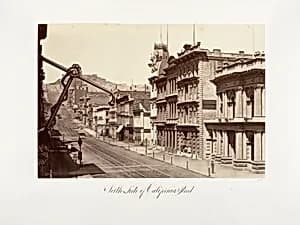
North Side of California Street
1864, printed ca. 1876
Medium
Albumen silver print from glass negative
Classification
Photographs
Department
Photographs
Museum
Metropolitan Museum of Art, New York, NY
Credit
Gift of Carole and Irwin Lainoff, Ruth P. Lasser and Joseph R. Lasser, Mr. and Mrs. John T. Marvin, Martin E. and Joan Messinger, Richard L. Yett and Sheri and Paul Siegel, 1986
Accession Number
1986.1189.7
Rights
Public Domain
Tags
Art Historical Context
Step into the bustling heart of 1860s San Francisco with Carleton E. Watkins's *North Side of California Street* (1864, printed ca. 1876). This albumen silver print from a glass negative captures the north side of one of the city's key thoroughfares during a time of explosive growth following the Gold Rush. Watkins, a pioneering photographer of the American West, masterfully documented the rapid urbanization of California, turning his lens on both majestic landscapes and evolving cityscapes like this one. The albumen process, popular in the mid-19th century, produced richly toned images with fine detail, allowing Watkins to showcase architectural details, horse-drawn carriages, and pedestrians amid wooden storefronts and emerging commercial hubs. Printed later around 1876, it reflects how these photographs served as enduring records, shared in albums and exhibitions to promote the region's progress. Housed in The Metropolitan Museum of Art's Photographs Department, this work highlights Watkins's technical prowess with large-format glass negatives, offering a vivid snapshot of San Francisco's transformation from frontier outpost to thriving metropolis. A testament to photography's role in shaping perceptions of the American West, it invites visitors to ponder the energy of a city on the rise.
About the Artist
Carleton E. Watkins · 1829–1916
Carleton E. Watkins (1829–1916), one of America's pioneering landscape photographers, was born on November 11, 1829, in Oneonta, New York, the eldest of eight children to carpenter John Watkins and innkeeper Julia. Drawn by the Gold Rush, he arrived in San Francisco in 1851 at age 22 alongside childhood friend Collis Huntington, who later became a railroad tycoon. Initially working as a carpenter ...