
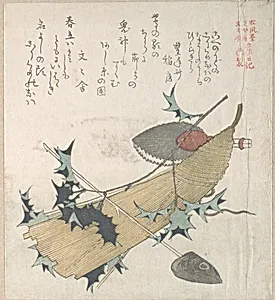
Objects Representing the Ceremony of Exorcising Demons, One of the New Year Performances
19th century
Medium
Woodblock print (surimono); ink and color on paper
Dimensions
7 15/16 x 7 1/8 in. (20.2 x 18.1 cm)
Classification
Prints
Culture & Period
Japan · Edo period (1615–1868)
Department
Asian Art
Museum
Metropolitan Museum of Art, New York, NY
Credit
H. O. Havemeyer Collection, Bequest of Mrs. H. O. Havemeyer, 1929
Accession Number
JP2063
Rights
Public Domain
Tags
Art Historical Context
In the lively tradition of Edo-period Japan (1615–1868), Kubo Shunman's *Objects Representing the Ceremony of Exorc Demons, One of the Year Performances* captures spirited rituals that ushered in the New Year. Created in the 19th century this intimate woodblock print (surimono)—measuring just 7 15/16 x 7 1/8 inches—showcases ceremonial objects used in exorcism rites to banish evil spirits and ensure prosperity. Shunman, a master of uyo-e, infused the scene with meticulous detail, using ink and vibrant colors on paper to evoke the festive chaos of these communal performances. Surimono like this one were bespoke luxury prints, often commissioned for private New Year's exchanges among poets and elites, blending art with seasonal poetry (though not visible here). The medium's significance lies in its refined techniques—crisp lines, subtle shading, and occasional metallic accents—elevating everyday rituals into poetic treasures. These prints preserved cultural practices amid Japan's urban flourishing, offering a window into how communities warded off misfortune with drama and symbolism. Part of the Metropolitan Museum of Art's H. O. Havemeyer Collection, this work highlights Shunman's versatility beyond actor prints, celebrating Japan's enduring blend of spirituality and artistry. A delightful glimpse into festive resilience! (198 words)
About the Artist
Kubo Shunman · 1757–1820
Japanese, 1757–1820