
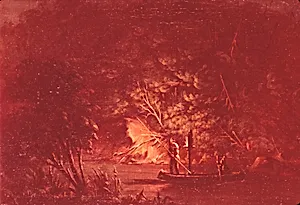
Ojibwe Spearing Salmon by Torchlight
1846-1848
Medium
Painting
Classification
Painting
Department
Smithsonian Collection
Museum
Smithsonian American Art Museum
Credit
Smithsonian American Art Museum, Gift of Mrs. Joseph Harrison, Jr.
Accession Number
1985.66.575
Rights
Public Domain
Tags
About this artwork
“I mentioned that the Chippeways [Ojibwe/Chippewa] living in the vicinity of the Sault, live entirely on fish; and it is almost literally true also, that the French and English, and Americans, who reside about there live on fish, which are caught in the greatest abundance in the rapids at that place, and are, perhaps, one of the greatest luxuries of the world.” George Catlin painted this work in Paris between 1846 and 1848. (Catlin, Letters and Notes, vol. 2, no. 54, 1841; reprint 1973)
Art Historical Context
George Catlin’s “Ojibwe Spearing Salmon by Torchlight,” painted between 1846 and 1848 while the artist was living in Paris, captures a nighttime fishing scene on the rapids near Sault Ste. Marie. An Ojibwe fisherman balances in a canoe, using the glow of a torch to spot salmon in the shallow, fast-moving water. Catlin, who traveled extensively among Native nations in the 1830s, based the work on direct observations he recorded in his 1841 publication *Letters and Notes*. The painting belongs to Catlin’s larger project of documenting Indigenous lifeways at a moment of rapid change. He noted that the Ojibwe living near the Sault “live entirely on fish,” a staple so abundant that French, English, and American residents also depended on the same resource. By rendering the technique of torchlight spearing, Catlin preserved both a practical skill and the seasonal rhythms of Ojibwe life. As a work on canvas rather than the more common field sketches of the period, the painting allowed Catlin to bring detailed scenes of Native America to European audiences unfamiliar with the continent’s interior. Today it stands as a valuable historical record within the Smithsonian American Art Museum’s collection, gifted by Mrs. Joseph Harrison, Jr.
About the Artist
George Catlin · 1796–1872
George Catlin (1796–1872), born in Wilkes-Barre, Pennsylvania, to Putnam Catlin and Polly Sutton—who had been captured by Native Americans during the 1778 Battle of Wyoming—initially pursued a legal career. Trained at Litchfield Law School, he was admitted to the bar in 1819 but abandoned law after two years to study art in Philadelphia in 1823. Self-taught as a portraitist, Catlin quickly gained ...