
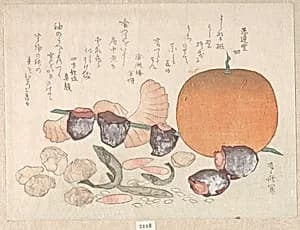
Orange, Dried Persimmons, Herring-Roe and Different Nuts; Food Used for the Celebration of the New Year
19th century
Medium
Woodblock print (surimono); ink and color on paper
Dimensions
5 1/2 x 7 7/16 in. (14 x 18.9 cm)
Classification
Prints
Culture & Period
Japan · Edo period (1615–1868)
Department
Asian Art
Museum
Metropolitan Museum of Art, New York, NY
Credit
H. O. Havemeyer Collection, Bequest of Mrs. H. O. Havemeyer, 1929
Accession Number
JP2118
Rights
Public Domain
Tags
Art Historical Context
In the intimate world of Edo-period Japan (1615–1868), Ryūryūkyo Shinsai's *Orange, Dried Persimmons Herring-Roe and Different; Food Used for the of the New Year*19th century) captures the joyful abundance of seasonal festivities. This woodblock print or *surimono*, measures just 5½ x 7⅜ inches, a format prized for private commissions like New Year's greetings shared among poetry circles or friends. Rendered in vibrant ink and color on paper, it showcases Shinsai's mastery in the ukiyo-e tradition, emphasizing everyday beauty with meticulous detail—from the glossy sheen of oranges to the textured roe. Surimono like this one were luxurious, often featuring embossed effects or metallic pigments (though not specified here), distinguishing them from mass-produced prints. The depicted foods are quintessential *osechi*—traditional New Year's dishes symbolizing good fortune: dried persimmons evoke prosperity, herring-roe fertility and abundance, nuts longevity, and oranges vitality. During the Edo era's prosperous urban culture, such imagery reinforced communal rituals amid the lunar calendar's turning point. Part of the Metropolitan Museum of Art's H. O. Havemeyer Collection, this print invites us to savor Japan's harmonious blend of art and ritual, where even humble ingredients become emblems of hope and renewal.
About the Artist
Ryūryūkyo Shinsai · 1799–1823
Ryūryūkyo Shinsai (柳々居辰斎), active from 1799 to 1823, was a prominent Japanese ukiyo-e printmaker based in Edo (modern Tokyo), renowned for his mastery of surimono—luxurious, privately commissioned woodblock prints produced for elite poetry circles and New Year's celebrations. He began his training under Tawaraya Sōri before becoming a student of the legendary Katsushika Hokusai, from whom he recei...