
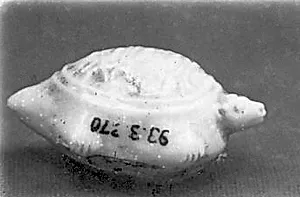
Ornament in the Form of a Tortoise
Unknown Artist
1800
Medium
White porcelain (Hirado ware)
Dimensions
L. 1 in. (2.5 cm)
Classification
Ceramics
Culture & Period
Japan · Edo period (1615–1868)
Department
Asian Art
Museum
Metropolitan Museum of Art, New York, NY
Credit
Gift of Charles Stewart Smith, 1893
Accession Number
93.3.270
Rights
Public Domain
Tags
Art Historical Context
This delicate *Ornament in the Form of a Tortoise*, crafted around 1800 during Japan's Edo period (1615–1868), exemplifies the refined artistry of Hirado ware, a prized white porcelain from the kilns of Hirado Island in Nagasaki Prefecture. Measuring just 1 inch (2.5 cm) in length, this tiny ceramic tortoise captures the era's mastery of miniaturization, with its smooth, translucent body and lifelike detailing evoking the natural grace of the animal. Hirado ware, produced primarily for export and elite domestic use, was celebrated for its thin, eggshell-like porcelain and intricate molding techniques, which allowed for such precise, naturalistic forms. In Edo-period Japan, a time of relative peace and cultural flourishing, small ornaments like this served practical yet decorative purposes—perhaps as a netsuke toggle for securing pouches or simply as a collector's charm. The tortoise holds deep cultural symbolism in Japanese lore, representing longevity, wisdom, and steadfastness, making it a fitting motif for personal adornments. Donated to the Metropolitan Museum of Art in 1893 by Charles Stewart Smith, this piece highlights the global appreciation for Japanese ceramics during the late 19th century, bridging East and West in the world of fine art.