
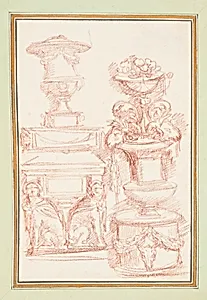
Ornamental detail with botanical motifs
Classification
ornament
Department
Smithsonian Collection
Museum
Smithsonian American Art Museum
Credit
Gift of Noah Butkin
Accession Number
1977-110-4-20
Rights
Public Domain
About this artwork
Research in Progress
Art Historical Context
Jean-Robert Ango, a French artist active in Rome 1759 to 1770, crafted this *Ornamental detail with motifs* around the mid-18th century, a time when European decorative arts flourished amid the Rococo style's elegant flourishes and growing fascination with nature. Working far from his homeland in the vibrant artistic hub of Rome, Ango specialized in intricate ornaments that blended French refinement with Italian influences, capturing the era's delight in organic forms like twisting vines and blooming flowers. These botanical motifs reflect the Enlightenment's emphasis on the natural world, often adorning architecture, furniture, and silverwork to evoke harmony and abundance. Though the medium remains unidentified amid ongoing research, the piece exemplifies the precision and whimsy of period ornamentation, where delicate details invited viewers to trace leaves and petals in endless, rhythmic patterns. Now part of the Smithsonian American Art Museum's collection through the generous gift of Noah Butkin, this work offers a glimpse into 18th-century design innovation. As curators continue to uncover its story, it reminds us how such small-scale artistry shaped grand interiors and everyday elegance across Europe.