
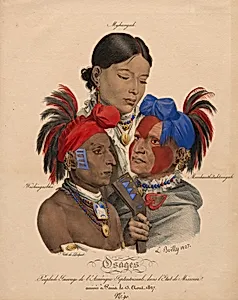
Osage Indians: Mohongo, Washingsabba (or Black Bird), and Big Soldier
Medium
Classification
Department
Smithsonian Collection
Museum
Smithsonian American Art Museum
Credit
National Portrait Gallery, Smithsonian Institution
Accession Number
S/NPG.2011.5
Rights
Public Domain
Tags
Art Historical Context
In 1827, French artist Louis-Léopold Boilly captured the striking likenesses of three Osage Nation members—Mohongo, a woman; Washingsabba, also known as Black Bird, a man; and Big Soldier, a man—in this evocative print. Boilly, renowned for his realism and genre scenes during France's Revolutionary and Restoration eras, turned his keen eye to these Indigenous portraits, likely drawing from images of an 1825 Osage delegation Washington, D.C. The artwork, now in the Smithsonian American Art Museum's collection, offers a window into early 19th-century cross-cultural encounters. As a print, this piece exemplifies the era's lithographic techniques, which allowed for widespread reproduction and dissemination of exotic "noble savage" imagery popular in Europe and America. Details like Big Soldier's earring, necklace, and staff highlight Osage regalia, emphasizing cultural identity amid rapid change from U.S. expansion and treaties. Boilly's precise rendering preserves their dignity and individuality, contrasting with stereotypical depictions. This portrait trio holds historical significance, documenting Osage leaders during a pivotal time of negotiation and displacement, while showcasing Boilly's skill in bridging artistic traditions across continents. A testament to curiosity and exchange, it invites visitors to reflect on Indigenous resilience.