
Osceola
Medium
Classification
Department
Smithsonian Collection
Museum
Smithsonian American Art Museum
Credit
National Portrait Gallery, Smithsonian Institution
Accession Number
NPG.94.53
Rights
Public Domain
Tags
Art Historical Context
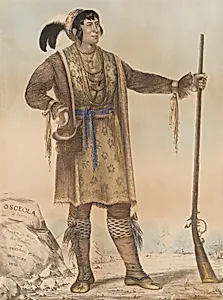
George Catlin's *Osceola* (1838), a striking print from the Smithsonian American Art Museum's collection, captures the Seminole leader Osceola a powerful portrait. Catlin, a pioneering 19th-century American artist dedicated much of his career to documenting American life through vivid portraits and scenes, traveling extensively in the 1830s to paint tribal leaders before widespread displacement. This work exemplifies his commitment to preserving Indigenous cultures on canvas—and in this case, through print reproduction for wider audiences. Osceola, adorned with a feathered turban, beaded gorget, and powder horn slung over his shoulder alongside a rifle, embodies fierce resistance. As a key figure in the Second Seminole War (1835–1842), he led guerrilla campaigns against U.S. forces seeking to remove the Seminoles from Florida. Captured under a flag of truce in 1837, he died in captivity the following year, making Catlin's timely depiction a poignant historical record. The print medium allowed Catlin's detailed realism—highlighting Osceola's dignified gaze and traditional regalia—to reach beyond elite viewers, underscoring the artwork's role in early ethnographic art and raising awareness of Native American struggles during a turbulent era of U.S. expansion.