
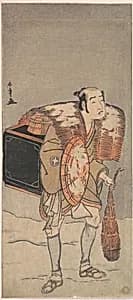
Otani Tomoemon (?) as a Peddler Trudging Through the Snow
ca. 1778
Medium
Woodblock print (nishiki-e); ink and color on paper
Dimensions
12 9/16 x 5 17/32 in. (31.9 x 14.1 cm)
Classification
Prints
Culture & Period
Japan · Edo period (1615–1868)
Department
Asian Art
Museum
Metropolitan Museum of Art, New York, NY
Credit
Purchase, Joseph Pulitzer Bequest, 1918
Accession Number
JP348
Rights
Public Domain
Tags
Art Historical Context
In the vibrant world of Edo-period Japan (1615–1868), Katsukawa Shunshō's *Otani Tomoemon (?) a Peddler Trud Through the Snow* (ca. 1778) captures the dramatic flair of Kabuki theater. Shunshō, a leading ukiyo-e master renowned for his yakusha-e (actor prints), depicts the famed performer Otani Tomoemonpossibly in this weary peddler role—braving a snowy trek. These intimate woodblock prints, measuring just 12 9/16 x 5 17/32 inches, were affordable souvenirs for urban fans, immortalizing stars of the "floating world" of entertainment in bustling Edo (modern Tokyo). This nishiki-e, or "brocade print," showcases Shunshō's mastery of full-color woodblock techniques, a breakthrough in the 1760s that layered vibrant inks for lifelike depth and texture. Snowflakes and layered robes evoke the harsh winter, highlighting the actor's expressive pose and costume details central to Kabuki's stylized drama. Such prints not only popularized theater culture but also elevated printmaking as high art, influencing global aesthetics. Held in the Metropolitan Museum of Art's Asian Art collection (Purchase, Joseph Pulitzer Bequest, 1918), this work offers a window into 18th-century Japan's blend of performance, nature, and everyday resilience—perfect for savoring the artistry of a bygone era.
About the Artist
Katsukawa Shunshō 勝川春章 (Japanese) · 1726 –1792
Japanese, 1726–1792