
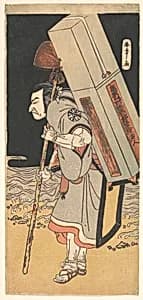
The actor Nakamura Nakazo as a rokuju-rokubu (pilgrim to Buddhist temple)
ca. 1780
Medium
Woodblock print (nishiki-e); ink and color on paper
Dimensions
12 1/4 x 5 7/8 in. (31.1 x 14.9 cm)
Classification
Prints
Culture & Period
Japan · Edo period (1615–1868)
Department
Asian Art
Museum
Metropolitan Museum of Art, New York, NY
Credit
The Howard Mansfield Collection, Purchase, Rogers Fund, 1936
Accession Number
JP2690
Rights
Public Domain
Tags
Art Historical Context
Step into the vibrant world of Edo-period Japan with Katsukawa Shunshō's *The Actor Nakamura Nakazō as a Rokuju-rokubu (Pilgrim to Buddhist Temple)*, a stunning woodblock print from around 1780. This nishiki-e, or "brocade picture," captures famous kabuki actor Nakamura Nakō in the guise of a devoted pilgrim undertaking the sacred 88-temple circuit on Shikoku Island—though the title playfully nods to the "66 provinces" pilgrimage motif. Shunshō, a master of the Katsukawa school, excels in yakusha-e (actor prints), rendering Nakazō's expressive face and dynamic pose with remarkable realism and theatrical flair. The medium's brilliance lies in its intricate woodblock technique: multiple carved blocks layered with vibrant inks created the rich colors and fine details that made nishiki-e a sensation among urban audiences in 18th-century Tokyo. Shunshō's style emphasized psychological depth in performers, influencing generations of ukiyo-e artists like his pupil Shun'ei. In Edo society, kabuki stars like Nakazō were celebrities, and prints like this democratized theater fandom, adorning homes and sparking cultural buzz. Housed in the Metropolitan Museum of Art's Asian Art collection, this 12¼ × 5⅞-inch gem from The Howard Mansfield Collection invites us to ponder devotion, performance, and artistry intertwined.
About the Artist
Katsukawa Shunshō 勝川春章 (Japanese) · 1726 –1792
Japanese, 1726–1792