
Page from the Ten Bamboo Studio Manual of Painting and Calligraphy
first edition printed in 1633
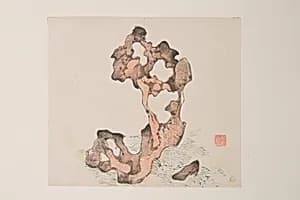
Medium
Polychrome woodblock print; ink and color on paper
Dimensions
9 3/8 x 10 3/4 in. (23.8 x 27.3 cm)
Classification
Prints
Culture & Period
China · Qing dynasty (1644–1911), Kangxi period (1662–1722)
Department
Asian Art
Museum
Metropolitan Museum of Art, New York, NY
Credit
Rogers Fund, 1924
Accession Number
CP88
Rights
Public Domain
Art Historical Context
This exquisite page hails from the *Ten Bamboo Studio Manual of and Calligraphy* by Hu Zhengyan, a Ming dynasty artist, publisher, and innovator whose first edition was printed in 1633. at his Ten Bamboo Studio in Nanjing, the manual exemplifies the zenith of Chinese woodblock printing during a transitional era leading into the Qing dynasty (4–1911). This particular polychrome woodblock print rendered in vibrant ink and on paper (9 3/8 x 10 3/4 in.), likely dates to the Kangxi period (1662–1722), showcasing the enduring popularity of Hu's techniques through later editions. Hu Zhengyan revolutionized printmaking with his "Ten Bamboo" method, employing multiple woodblocks for over ten colors, subtle textures, and even embossing (gauffrage) to mimic the fluid brushwork of paintings and calligraphy. Far beyond mere reproduction, these prints captured the elegance of literati arts—flowers, birds, landscapes, and scripts—making high art accessible to scholars and collectors. Culturally, the manual bridged painting and print traditions, influencing East Asian graphic arts for centuries. Acquired by The Metropolitan Museum of Art via the Rogers Fund in 1924, it invites visitors to marvel at the fusion of precision craftsmanship and poetic beauty in China's golden age of printing.
About the Artist
Hu Zhengyan · 1584–1634
Hu Zhengyan (胡正言, c. 1584–c. 1674) was a Chinese artist, publisher, seal-carver, and printmaking innovator who lived through the turbulent transition from the Ming to the Qing dynasty. Born in Xiuning in Anhui province, he eventually settled in Nanjing, where he established his home and workshop on a hill within the northern city wall and named the property the Ten Bamboo Studio, or Shizhuzhai, af...