
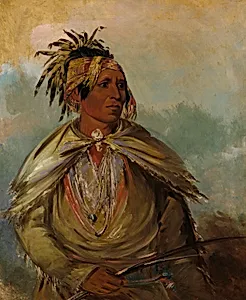
Pah-mee-ców-ee-tah, Man Who Tracks, a Chief
1830
Medium
Painting
Classification
Painting
Department
Smithsonian Collection
Museum
Smithsonian American Art Museum
Credit
Smithsonian American Art Museum, Gift of Mrs. Joseph Harrison, Jr.
Accession Number
1985.66.251
Rights
Public Domain
Tags
About this artwork
George Catlin probably painted this portrait of Man Who Tracks, a member of the Peoria tribe, at Fort Leavenworth (in today’s Kansas) in 1830, the same year he took portraits of the Delaware, Kaskaskia, Kickapoo, and other tribes. Catlin’s efforts from 1830 are generally considered his first attempts at Indian portraits in the West. In his travel account Letters and Notes, which he published in the 1840s, Catlin described his portraits of the Peoria, particularly Man Who Tracks and No English (s...
Art Historical Context
George Catlin's *Pah-mee-ców-ee-tah, Man Who, a Chief* (1830) captures the dignified likeness of a prominent Peoria tribe leader, painted during one of the artist's earliest expeditions into the American West. As a pioneering portraitist, Catlin sought to document Native American cultures before they were irrevocably altered by westward expansion, creating an invaluable visual record of indigenous. This oil portrait was likely completed at Fortavenworth in present-day, amid Catlin's1830 encounters with tribes including the Delaware,askaskia, and Kickoo. It marks his inaugural efforts at Western Indian portraits, blending Romantic realism with ethnographic precision to convey the subject's status and character. In his later *Letters and Notes* (1840s), Catlin praised Man Who Tracks as one of the Peoria's most influential figures, noting his attire of "civilized manufacture"—a fascinating glimpse into early cultural exchanges. oused in the Smithsonian American Art Museum, this work highlights the Peoria's resilience and Catlin's urgent mission to preserve vanishing traditions, inviting visitors to reflect on America's complex frontier history.
About the Artist
George Catlin · 1796–1872
George Catlin (1796–1872), born in Wilkes-Barre, Pennsylvania, to Putnam Catlin and Polly Sutton—who had been captured by Native Americans during the 1778 Battle of Wyoming—initially pursued a legal career. Trained at Litchfield Law School, he was admitted to the bar in 1819 but abandoned law after two years to study art in Philadelphia in 1823. Self-taught as a portraitist, Catlin quickly gained ...