
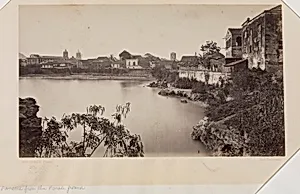
Panama from the Parade Ground
1875, published 1877
Medium
Photography-Photoprint
Classification
Photography-Photoprint
Department
Smithsonian Collection
Museum
Smithsonian American Art Museum
Credit
Smithsonian American Art Museum, Gift of Mitchell and Nancy Steir
Accession Number
2000.105.5
Rights
Public Domain
Tags
Art Historical Context
Step into the vibrant world of 19th-century photography with *Panama from the Parade Ground*1875, published 1877), a captivating photoprint by pioneering artist Eadweard Muy. Best known for his groundbreaking motion—like proving that all four hooves of a horse leave the ground during a gallop—this earlier work captures a sweeping vista of Panama's coastal town. From an elevated parade ground vantage, Muybridge frames clusters of houses hugging the shoreline, evoking the bustling energy of a tropical port hub along the Pacific coast. Created during Muybridge's travels through Central America, this image reflects the era's fascination with exotic locales amid expanding railroads and trade routes—the Panama Railroad, completed two decades prior, had transformed the isthmus into a vital global link. As a master of wet-collodion and albumen printing techniques, Muybridge delivered crisp, documentary precision that brought distant landscapes to life for armchair explorers back home. Published just two years later, it exemplifies his skill in stereo views and panoramic compositions, bridging landscape artistry with emerging photojournalism. Housed in the Smithsonian American Art Museum through a generous gift from Mitchell and Nancy Steir, this piece invites us to ponder Panama's colonial crossroads—where cultures mingled under swaying palms—while celebrating Muybridge's role in photography's evolution from novelty to narrative powerhouse.
About the Artist
Eadweard Muybridge · 1830–1904
Eadweard Muybridge (1830-1904) was an English-American photographer who revolutionized the understanding of motion through his pioneering chronophotographic studies. Born Edward James Muggeridge in Kingston upon Thames, England, he emigrated to America and became famous first for his dramatic landscape photographs of Yosemite Valley, then for his groundbreaking motion studies that proved horses li...