
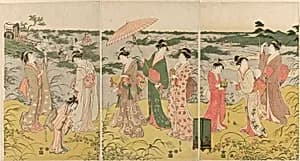
Parody of courtly insect hunt
c. 1791/92
Medium
Color woodblock print; oban triptych
Dimensions
39 × 73.5 cm (15 3/8 × 28 15/16 in.)
Classification
woodblock print
Department
Arts of Asia
Museum
Art Institute of Chicago
Accession Number
21696
Rights
Public Domain
Art Historical Context
Step into the playful world of Edo-period Japan *Parody of Courtly Insect Hunt*, captivating color woodblock print by Chôbunsai Eishi, created around 1791–92. This oban triptych— large sheets joined to form a panoramic scene measuring 39 × 73.5 cm—showcases Eishi's mastery of ukiyo-e, the "pictures of the floating world" celebrated everyday pleasures, theater, and beauty. Housed in the Art Institute of Chicago's Arts Asia collection, it humorously reimagines an aristocratic pastime: the elegant pursuit of insects like butterflies and crickets, often depicted in refined courtly settings. Eishi, renowned for his graceful bijin-ga (images of beautiful women), infuses this work with satire, likely portraying courtesans or commoners mimicking noble hunts in a lighthearted twist. Insect collecting was a cultured hobby among samurai and elites, symbolizing harmony with nature, but Eishi's parody pokes fun at social pretensions during Japan's vibrant Edo era (1603–1868), when ukiyo-e prints democratized art for urban audiences. The triptych format allowed for dynamic composition and vivid storytelling, with intricate woodblock techniques layering delicate colors and fine lines to evoke movement and texture. This piece exemplifies how prints like these captured cultural whimsy, bridging high art and popular entertainment.
About the Artist
Chôbunsai Eishi · 1756–1829
Chôbunsai Eishi, born Hosoda Tokitomi in 1756 to a prosperous samurai family of the Fujiwara clan in Edo, inherited a substantial stipend of 500 koku of rice annually. His grandfather had served as the shogunate's Treasury Minister, and upon his father Hosoda Tokiyuki's death in 1772, Eishi became family head while holding a position in Shogun Tokugawa Ieharu's palace from 1781. Unusually for a uk...