
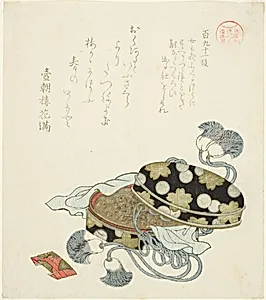
Passage 191 (Hyaku kyujuichi dan), from the series "Essays in Idleness for the Asakusa Group (Asakusagawa Tsurezuregusa)"
early 19th century
Medium
Color woodblock print; shikishiban, surimono
Dimensions
21.7 × 18.5 cm (8 9/16 × 7 5/16 in.)
Classification
woodblock print
Department
Arts of Asia
Museum
Art Institute of Chicago
Accession Number
81363
Rights
Public Domain
Art Historical Context
Kubo Shunman's *Passage 191 (Hyaku kyujuichi dan, from the series *ays in Idleness for Asakusa Group (akusagawa Tsuregusa)*, is a delightful early 19th color woodblock print. Created during Japan's Edo period, this shikishiban-format surimono—roughly square and measuring 21.7 × 18.5 cm—exemplifies the artist's mastery in the ukiyo-e tradition, blending whimsy with refined craftsmanship. Surimono were luxury prints commissioned by poetry circles or wealthy patrons, often featuring embossed effects, mica dusting, and vibrant colors achieved through precise woodblock carving and multiple color applications. Shunman, a versatile ukiyo-e artist known for his poetic illustrations, draws from Yoshida Kenko's medieval *Tsurezuregusa* (Essays in Idleness), reimagining its contemplative passages in the lively Asakusa district of Edo (modern Tokyo). This series playfully updates the classic text with urban scenes, highlighting Shunman's skill in capturing everyday elegance and humor. Housed in the Art Institute of Chicago's Arts of Asia department, this intimate print offers a window into Edo Japan's cultured leisure, where art, literature, and social gatherings intertwined, making it a gem for admirers of Japanese printmaking's golden age.
About the Artist
Kubo Shunman · 1757–1820
Japanese, 1757–1820