
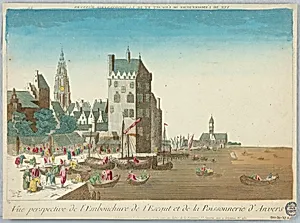
Peep-show, Vue Perspective de l'Embouchure de l'Escaut et de la Possonnerie d'Anvers
ca. 1750
Medium
Classification
Department
Smithsonian Collection
Museum
Smithsonian American Art Museum
Credit
Gift of Mrs. Edward R. Wharton
Accession Number
1901-30-27
Rights
Public Domain
About this artwork
Research in Progress
Art Historical Context
Step into the enchanting world of 18th optical amusements with *Peep-show, Vue de l'Embouchure de l'Escaut et de la Possonnerie'Anvers*, a captivating print from around 1750. This artwork depicts a vivid perspective view of the Schet River's mouth and Antwerp's bustling fish market (sonnerie), transforming a simple print into an immersive experience. Peep-shows like this were handheld paper devices, viewed through a small lens or peephole, creating a startling sense of depth and realism through clever foreshortening and shading—popular entertainments in Europe that brought distant scenes to life for curious viewers at home. Created by an unknown artist, this print exemplifies the era's fascination with perspective and topography, blending tourism, trade, and technology. Antwerp, a thriving port city in the Austrian Netherlands, was a hub of commerce along the Scheldt, and such views celebrated its maritime vibrancy amid the Enlightenment's love for scientific illusion. As a print medium, it relied on precise engraving techniques to achieve its trompe l'oeil effect, making grand landscapes accessible to the middle class. Now housed in the Smithsonian American Art Museum's Print Collection—thanks to a gift from Mrs. Edward R. Wharton—this rare survivor invites us to peer through time, evoking the wonder of 1750s street vendors hawking these "worlds in a box." Research continues to uncover more about its creation, but its charm endures as a window to Europe's Age of Exploration.
About the Artist
Unknown
The artist designated as "Unknown" in our virtual museum's collection exemplifies a poignant chapter in art history: creators whose identities have faded into obscurity despite the enduring power of their work. With only one known artwork attributed to them in our holdings, this figure represents countless anonymous hands that shaped visual culture across centuries. Museums worldwide, including th...