
Persian Travelogue: A Diary of a Journey through the region of Fars
1838 CE
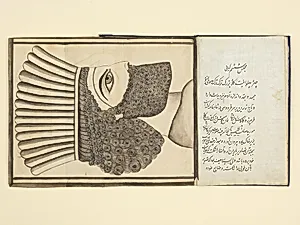
Medium
Black ink on paper; blue velvet binding with a flap, tight back case binding sewn onto two cotton/hemp cords (laced in), with marbled paper doublures
Dimensions
14 × 8 7/8 × 1 in. (35.6 × 22.6 × 2.55 cm)
Classification
Manuscripts
Culture
Qajar
Department
Ancient Near Eastern Art
Museum
Metropolitan Museum of Art, New York, NY
Credit
Purchase, Friends of Ancient Near Eastern Art and The Ishtar Society Gifts, 2019
Accession Number
2019.116
Rights
Public Domain
Art Historical Context
Step into the vibrant world of 19th-century Qajar Iran *Persian Travelogue: Diary of a Journey through the Region of Fars*, crafted in 1838 by Ahmadqqash. This intimate manuscript captures the artist's personal observations as he traversed the historic Fars province—home to ancient Persepolis and bustling Shiraz—offering a rare glimpse into everyday life, landscapes, and culture during the reign of Mohammad Shah Qajar. As a "naqqash" (painter or illustrator), Naqqash likely infused his diary with vivid textual descriptions, blending travel narrative with artistic insight in the elegant tradition of Persian literature. The book's medium showcases Qajar mastery of bookbinding: black ink calligraphy on paper, encased in luxurious blue velvet with a protective flap, tight-back case sewn onto sturdy cotton/hemp cords, and ornate marbled paper doublures. Measuring a compact 14 × 8⅞ × 1 inches, it was designed for portability, reflecting the practical elegance of Persian manuscripts prized for both utility and beauty. Acquired by the Metropolitan Museum of Art in 2019, this treasure from the Ancient Near Eastern Art department illuminates Qajar Iran's scholarly and artistic heritage. Travelogues like this preserved personal histories amid a dynasty renowned for its intricate arts, providing invaluable context on regional identity and mobility in pre-modern Persia.