
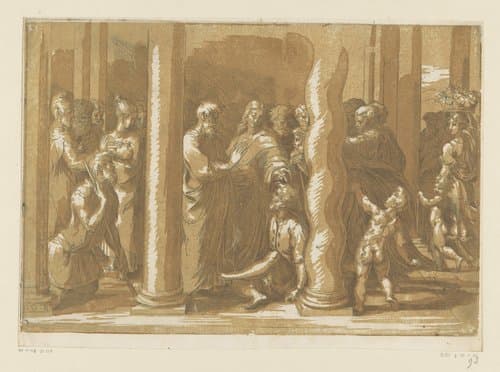
Petrus en Johannes genezen een verlamde man bij de tempelpoort
1513 - 1540
Medium
etching
Dimensions
278; 408
Rights
Public Domain
About this artwork
height 278 mm x width 408 mm
Art Historical Context
In this striking etching titled *Petrus en Johanneszen een verlamde bij de tempelpo* (Peter and John Heal a Lame Man at Temple Gate), Parmigian captures a pivotal biblical moment from the Acts of the Apostles. The scene depicts the apostles Peter and John miraculously healing a paralyzed beggar at the temple's Beautiful Gate, a story symbolizing early Christian faith and divine power. Created by the Italian Mannerist master Francesco Parmigianino (1503–1540), the work reflects his elegant style, characterized by graceful, elongated figures and a sense of ethereal movement that defined the Mannerist movement's departure from High Renaissance balance. Measuring 278 mm high by 408 mm wide, this etching showcases Parmigianino's pioneering skill in printmaking. Etching, a technique involving acid to bite designs into metal plates, allowed for intricate lines and tonal subtleties that mimicked drawing. Parmigianino was among the first artists to elevate etching to a fine art form, producing small, reproductive prints that spread his innovative Mannerist aesthetic across Europe during the 16th century. This piece not only illustrates a foundational Christian narrative but also highlights the cultural role of religious art in the Reformation era, bridging devotion and artistic experimentation. Visitors will appreciate its delicate precision, a testament to Parmigianino's genius in translating spiritual drama onto paper.
About the Artist
Parmigianino · 1503–1540
Parmigianino (1503–1540), born Girolamo Francesco Maria Mazzola, was an Italian painter and printmaker who became one of the most influential figures of the first generation of Mannerist artists. Orphaned before his second birthday, he was raised by his painter uncles in Parma and showed extraordinary precocity, completing a major altarpiece by age eighteen. His elegant, sophisticated style—charac...