
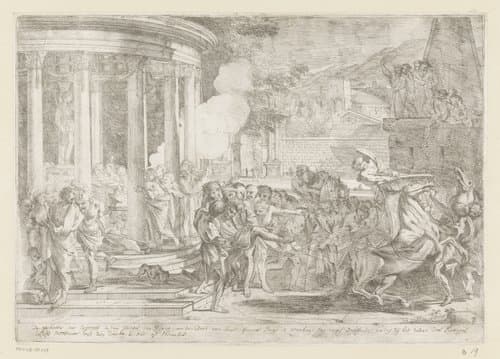
Sinorix wordt weggedragen na zijn vergiftiging
c. 1640
Medium
etching
Dimensions
414; 289
Rights
Public Domain
About this artwork
De tetrarch Sinorix is vergiftigd door Camma, een vrouw wiens echtgenoot hij had vermoord. Sinorix wordt gedragen naar zijn wagen die rechts klaarstaat. Links een ronde tempel van Diana. Scène uit Plutarchus' 'De Mulierum Virtutibus'.
Art Historical Context
Pietro Testa’s etching *Sinorix wordt weragen na zijn vergift* (c. 1640) captures a dramatic moment from classical antiquity, rendered with the intricate precision of 17th-century Baroque printmaking. Measuring 289 × 414 mm, this depicts the Galatian tetrarch Sinor being carried away after being poisoned by Camma, a widow seeking vengeance for her murdered husband. To the right, his chariot awaits; to the left stands a round temple of Diana, evoking the ancient sacred landscape. The scene draws directly from Plutarch’s *De Mulierum Virtutibus* (On the Virtues of Women), a text celebrating female courage and moral fortitude in the ancient world. Testa, an Italian artist active in Rome, often turned to classical sources for inspiration, blending mythological drama with historical narrative to explore themes of justice and retribution. This etching highlights Camma’s triumph through cunning, resonating in a era when women’s agency was rarely depicted so boldly. As an etching, the work showcases Testa’s mastery of acid-bitten lines on a metal plate, allowing for rich tonal contrasts and fine details in figures and architecture—hallmarks of Baroque dynamism. Printed from a single plate, it made classical stories accessible to a wider audience, bridging antiquity and the Renaissance revival of Plutarch’s moral tales. A captivating window into 17th-century interpretations of the past!
About the Artist
Pietro Testa · 1612–1650
Pietro Testa was born in Lucca in 1612 and, in accordance with the conventions of Italian artistic training, made his way to Rome while still young. There he studied under two of the leading painters of the early seventeenth century: Domenichino, from whom he absorbed a taste for classical restraint and narrative clarity, and Pietro da Cortona, whose more exuberant Baroque manner offered a contras...