
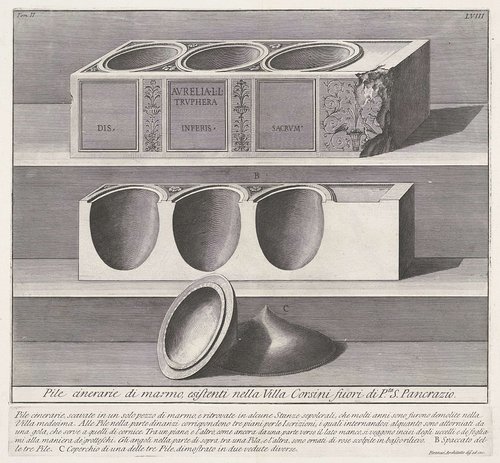
Pile cinerarie di marmo, esistenti nella Villa Corsini fuori di P.ta S. Pancrazio
c. 1756 - c. 1757
Medium
etching
Dimensions
398; 480
Rights
Public Domain
About this artwork
verzamelaarsmerk, verso, gestempeld: Lugt 2228
Art Historical Context
Giovanni Battista Piranesi's etching *Pile cinerarie di marmo, esistenti nella Villaini fuori di P.ta. Pancrazio* (c. 1756–1757) captures a pair of ancient marble cinerary urns housed in the Villa Corsini, just outside Rome's Porta S. Pancrazio gate. Measuring 398 × 480 mm, this exemplifies Piranesi's lifelong passion for Roman antiquities, documenting artifacts that fueled the 18th-century neoclassical revival. As a master of the veduta tradition—topographical views infused with dramatic grandeur—Piranesi meticulously rendered the urns' intricate carvings, evoking the solemnity of ancient Roman funerary practices. Piranesi produced this plate amid his extensive series on vases, candelabra, and sarcophagi, preserving fragile relics threatened by time and neglect. His etchings, like this one bearing a collector's mark (Lugt 2228) on the verso, served as both scholarly records and artistic inspirations for architects and designers across Europe. The composition's shadowy depths and fine lines highlight Piranesi's etching prowess, using aquatint-like effects for texture and atmosphere. This artwork underscores Piranesi's role in romanticizing classical heritage, bridging archaeology and art to captivate Enlightenment audiences with Rome's enduring legacy. A testament to his visionary draftsmanship, it invites visitors to ponder the whispers of antiquity in every etched line.
About the Artist
Giovanni Battista Piranesi · 1720–1778
Giovanni Battista Piranesi (1720–1778) was an Italian printmaker, architect, and antiquarian whose visionary etchings of Rome and imaginary prisons revolutionized architectural representation and profoundly influenced both Neoclassicism and Romanticism. Piranesi stands as one of the most important printmakers of the eighteenth century, fundamentally shaping European perceptions of ancient Rome an...