
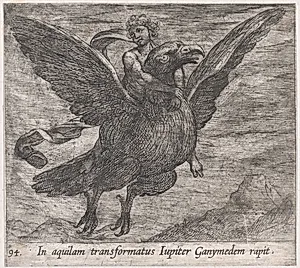
Plate 94: Jupiter and Ganymede (In aquilam transformatus Iupiter Ganymedem rapit), from Ovid's 'Metamorphoses'
1606
Medium
Etching
Dimensions
Sheet: 4 1/8 × 4 1/2 in. (10.4 × 11.5 cm)
Classification
Prints
Department
Drawings and Prints
Museum
Metropolitan Museum of Art, New York, NY
Credit
The Elisha Whittelsey Collection, The Elisha Whittelsey Fund, 1951
Accession Number
51.501.3930
Rights
Public Domain
Tags
Art Historical Context
This striking etching by Antonio Tempesta captures a dramatic moment from Ovid’s *Metamorphoses*: Jupiter, transformed into an eagle, swooping down to abduct the beautiful youth Ganymede. Created in 1606 as Plate 94 in a series of illustrations, the small print (just over four inches square) brings to life one of classical mythology’s most vivid tales of divine desire and transformation. Tempesta, an Italian artist active during the transition from late Renaissance to early Baroque, specialized in dynamic mythological scenes that made ancient stories accessible to a broader audience through the medium of print. Etching was particularly well suited for such narrative subjects, allowing Tempesta to render the powerful wings of the eagle, the twisting forms of the figures, and the sense of sudden movement with fine, expressive lines. These affordable prints circulated widely across Europe, helping to spread knowledge of Ovid’s tales beyond scholarly circles and inspiring later generations of artists and collectors. Today, this work in the Metropolitan Museum’s collection offers a window into how 17th-century viewers encountered classical mythology—not only through grand paintings but also through intimate, beautifully crafted prints that invited close looking and imaginative engagement with the stories.
About the Artist
Antonio Tempesta · 1555–1630
Antonio Tempesta (1555–1630), known as 'Il Tempestino,' was a Florentine painter and printmaker whose extraordinary output of approximately 1,700 etchings made him one of the most influential printmakers of the early Baroque period. Born in Florence and trained under Santi di Tito and the Flemish master Joannes Stradanus, he enrolled in the Accademia del Disegno in 1576 before relocating to Rome i...