
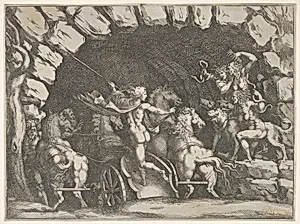
Pluto, seen from behind, entering the Underwold on his chairot, Cereberus and three Furies to right, from 'Giove che fulmina li giganti', after the frescoes on the ceiling of the Sala dei Giganti designed by Giulio Romano for the Palazzo del Te, Mantua
Medium
Etching
Dimensions
sheet: 7 1/2 x 10 1/8 in. (19.1 x 25.7 cm)
Classification
Prints
Department
Drawings and Prints
Museum
Metropolitan Museum of Art, New York, NY
Credit
Bequest of Phyllis Massar, 2011
Accession Number
2012.136.133
Rights
Public Domain
Tags
Art Historical Context
This etching by Pietro Santi Bartoli captures a dramatic moment from Giulio Romano’s celebrated fresco cycle in the Sala dei Giganti at Palazzo del Te in Mantua. Created around 1680, the print reproduces part of the ceiling’s mythological narrative, “Giove che fulmina li giganti,” depicting Pluto seen from behind as he enters the Underworld in his chariot, accompanied by the three-headed Cerberus and three Furies. Giulio Romano’s original Mannerist frescoes, painted in the 1530s for the Gonzaga family, transformed the room into a swirling vision of chaos and divine power, with the ceiling appearing to collapse onto viewers below. Bartoli’s etching skillfully translates the fresco’s dynamic energy into a portable medium, allowing wider audiences to appreciate the inventive composition long after the palazzo’s completion. The scene draws on classical mythology, showing Pluto’s realm in vivid contrast to Jupiter’s thunderbolts above, while details like rearing horses and fierce guardians heighten the sense of movement and tension. As a reproductive print, it highlights the enduring fascination with Romano’s theatrical vision of gods and giants. Measuring just over seven by ten inches, this work from the Metropolitan Museum’s collection offers an intimate window into one of the Renaissance’s most immersive decorative schemes.
About the Artist
Pietro Santi Bartoli|Giulio Romano · 1615–1700
Pietro Santi Bartoli, born in Perugia in 1635, emerged as a pivotal figure in the Roman antiquarian revival of the late seventeenth century. Relocating to Rome as a youth, he initially pursued painting, studying under the French artist Jean Lemaire—known as "Le Petit Lemaire"—and later under the esteemed Nicolas Poussin, whose classical rigor profoundly shaped his early approach. Though traces of ...