
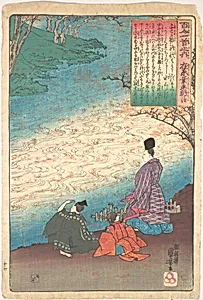
Poet with Two Pages on the Banks of the Tatsuta
ca. 1845
Medium
Woodblock print; ink and color on paper
Dimensions
H. 14 11/16 in. (37.3 cm); W. 10 1/16 in. (25.6 cm)
Classification
Prints
Culture & Period
Japan · Edo period (1615–1868)
Department
Asian Art
Museum
Metropolitan Museum of Art, New York, NY
Credit
Rogers Fund, 1925
Accession Number
JP1465
Rights
Public Domain
Tags
Art Historical Context
Created around 1845 during Japan’s Edo period, *Poet with Two Pages on the Banks of the Tatsuta* captures a serene literary moment along the Tatsuta River, a site celebrated in classical poetry for its brilliant autumn foliage. Utagawa Kuniyoshi (1797–1861), one of the leading masters of ukiyo-e, presents this refined scene with his characteristic flair for expressive figures and atmospheric landscapes. The print belongs to a broader tradition of illustrating famous poets and poetic episodes, making high literature visually accessible to a wide audience. Executed as a woodblock print in ink and color on paper, the work exemplifies the technical brilliance of Japanese printmaking. Multiple carved blocks allowed Kuniyoshi to layer vibrant hues and delicate details, from the flowing river to the subtle gestures of the figures. Such prints were affordable souvenirs and cultural touchstones, bridging the worlds of court poetry and everyday life. Today in the Metropolitan Museum of Art’s collection, this sheet offers viewers a glimpse into the Edo fascination with nature, verse, and storytelling, inviting quiet reflection on Japan’s enduring poetic heritage.
About the Artist
Utagawa Kuniyoshi · 1797–1861
Utagawa Kuniyoshi (1797–1861) was born in Edo to the silk-dyer Yanagiya Kichiyemon, originally bearing the childhood name Yoshisaburō. From a young age, he assisted in his family's pattern design work, which sharpened his innate mastery of color and textile motifs that would permeate his later prints. At around twelve years old, his prodigious drawing skills drew the attention of the renowned Utag...