
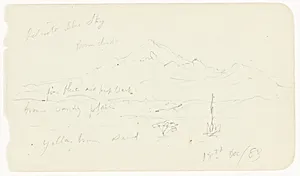
Popocatépetl, Mexico
December 18, 1883
Classification
Drawing
Department
Smithsonian Collection
Museum
Smithsonian American Art Museum
Credit
Gift of Louis P. Church
Accession Number
1917-4-1218
Rights
Public Domain
About this artwork
Research in Progress
Art Historical Context
Frederic Edwin Church, leading figure of the Hudson River School, renowned for his luminous landscapes that celebrated the sublime power of nature. Born in 1826, Church traveled the world to capture dramatic vistas, from the Andes to Niagara Falls. *Popocatépetl,* (December 18, 1883), a drawing from the Smithsonian American Art Museum's collection, depicts Mexico's towering active volcano—one of the country's most iconic natural landmarks, steeped in Aztec mythology as a symbol of fire and creation. Created late in Church's career, amid health challenges from rheumatoid arthritis, this work reflects his enduring passion for geological wonders. By 1883, Church had journeyed to Mexico seeking therapeutic warm climates, sketching on-site to document volcanic majesty akin to his earlier masterpieces like *Cotopaxi*. As a drawing—its precise medium still under research—it showcases his meticulous observation skills, likely using pencil or charcoal to render light, shadow, and steam with Hudson River precision. Gifted by Church's son Louis P. Church, this piece offers a rare intimate glimpse into the artist's process. It bridges American Romanticism with Latin American landscapes, inviting visitors to ponder humanity's awe before nature's volatility. (198 words)