
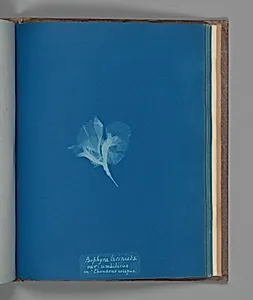
Porphyra laciniata, var: umbilicus on "Chondrus crispus"
ca. 1853
Medium
Cyanotype
Dimensions
Image: 25.3 x 20 cm (9 15/16 x 7 7/8 in.)
Classification
Photographs
Department
Photographs
Museum
Metropolitan Museum of Art, New York, NY
Credit
Gilman Collection, Purchase, The Horace W. Goldsmith Foundation Gift, through Joyce and Robert Menschel, 2005
Accession Number
2005.100.557 (139)
Rights
Public Domain
Art Historical Context
Step into the ethereal world of early photography with Anna Atkins' *Porphyra laciniata,: umbilicus on "ondrus crispus"*ca. 1853), a delicate cyanotype capturing two species of seaweed in intimate embrace. Atkins, a British botanist and pioneering photographer, created this image as part of her groundbreaking *British Algae: Cyan Impressions* (184–1853), the first book ever illustrated entirely with photographs. Here, the frilly edges of *Porphyra laciniata*—a red alga—overlay the crisp, fan-like fronds of *Chondrus crispus* (Irish moss), rendered in stunning Prussian blue tones against a pristine white ground. The cyanotype process, invented by Sir John Herschel in 1842, was Atkins' chosen medium for its simplicity and fidelity. By placing specimens directly on sensitized paper and exposing them to sunlight, she produced photograms—shadowless, life-sized impressions that blurred the line between scientific documentation and art. Measuring just 25.3 x 20 cm, this intimate print exemplifies her innovative fusion of botany and photography, predating most photographic publications. Housed in The Metropolitan Museum of Art's Gilman Collection, this work highlights Atkins' role as a trailblazing woman in Victorian science and art. It invites us to marvel at nature's intricate forms, preserved through a technique that influenced everything from blueprints to modern abstract photography. A testament to curiosity and precision, it remains a gem for seaweed enthusiasts and photography lovers alike.
About the Artist
Anna Atkins · 1799–1871
Anna Atkins (née Children), born on March 16, 1799, in Tonbridge, Kent, England, grew up immersed in the world of science thanks to her father, John George Children, a prominent chemist, zoologist, and curator at the British Museum. After her mother Hester's death shortly after childbirth in 1800, Anna formed a close bond with her father, receiving an exceptional scientific education rare for wome...