
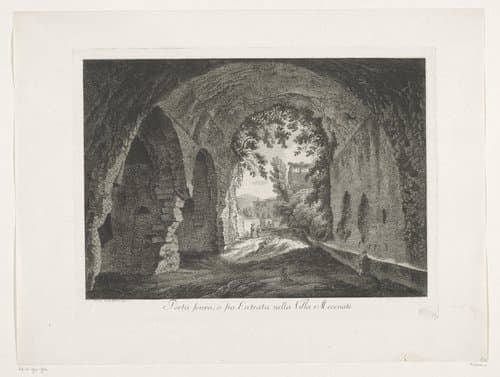
Porta Scura, o sia Entrata nella Vila Mecenate
Medium
etching
Dimensions
376; 281
Rights
Public Domain
About this artwork
Purchased with the support of the F.G. Waller-Fonds
Art Historical Context
Albert Christoph Dies’s1794 etching *a Scura, o Entrata nella Vilaenate* captures the shadowy to the ancient Villa of Maecenas in Tivoli, Italy. A German-born artist who spent much of his career in Rome, Dies specialized in topographical views that appealed to the era’s Grand Tour travelers. Working at the close of the eighteenth century, he recorded the crumbling remains of classical antiquity with both archaeological interest and romantic sensibility, preserving sites that were already celebrated for their literary associations with the Roman patron Maecenas. Executed in etching, the medium allowed Dies to render intricate stonework, deep shadows, and overgrown vegetation with remarkable precision on a modest copper plate. The horizontal format (281 × 376 mm) invites the viewer to step into the darkened archway, where light and texture contrast dramatically. Such prints circulated widely among European collectors, helping shape the period’s fascination with ruins as emblems of time’s passage and the enduring power of classical culture. Acquired with the support of the F.G. Waller-Fonds, the sheet remains a fine example of late-eighteenth-century veduta etching, bridging documentary record and poetic evocation for today’s museum visitors.
About the Artist
Albert Christoph Dies · 1755–1822
Albert Christoph Dies (1755–1822) was a German painter and writer who spent a significant portion of his career in Italy, working in the landscape tradition that drew so many Northern European artists to Rome during the late eighteenth century. Born in Hanover, Dies trained in the artistic milieu of the time and eventually made his way to Rome, where he became part of the community of German-speak...